Have you seen the '10 books that stayed with me' Facebook meme? You know, the one where - funnily enough - you name ten books that have stayed with you in some way and explain why. I mean, the clue's in the name really.
Anyway, I got tagged in it and as an avowed bookworm of 28 years standing I thought I'd give it a bash. I cannot abide long Facebook posts though - they make my page look messy and upset my OCD - so I've decided to do it as a blog post instead. I'm a rebel like that.
So here are my ten, in some kind of rough chronological order sort of:
1. The Very Hungry Caterpillar - Eric Carle
The first book I ever remember reading by myself. It's not big and it's not clever, but my god did I love it. If you're unaware of the highly complex plot, a caterpillar is born and proceeds to eat a lot until it turns into a butterfly. On the way, your author (aged approximately three at the time) learned numbers, days of the week and different fruit. The collage style illustrations are gorgeous too. Apparently this is also George W Bush's favourite book. Make of that what you will.
2. Sam's Sandwich - David Pelham
Another high brow option, Sam's Sandwich is about a boy making a sandwich for his sister and putting lots of bugs and gross stuff in it in the process. This one has stayed with me because I strongly remember my mum reading it to me and I know it's one of her favourite kids books that she's always used in her teaching career, which makes it doubly special because I know what an amazing teacher my mum is and how many other kids loved hearing her read my copy of this book as much as I did.
3. The Jolly Christmas Postman - Janet and Alan Ahlberg
I swear we get out of kids books in a while. Another one that I remember reading with my parents and I loved it because it was reading but it also had little surprises and games in it (I remember a jigsaw in particular) which I thought was basically magic at the time.
4. Charlie and the Chocolate Factory - Roald Dahl
I think this is the first 'grown up' book I read by myself. I read all of Roald Dahl's books when I was growing up - either for school or for pleasure - and it was hard to pick just one for this list. The Twits, Matilda and The BFG could easily be on here too. I went with Charlie and the Chocolate Factory in the end because it was the first one I read and I can still remember exactly what my copy looked like (hardback with a purple and orange striped spine if you were wondering). Plus it's just such a lovely story. I think it should be mandatory that everyone read it at least once before the age of 18.
5. Harry Potter and the Deathly Hallows - J K Rowling
My relationship with Harry Potter got off to a slow start. I didn't read any of the books and was initially fairly ambivalent to the films (apart from the second one, because Lockhart). Then when the final book was released my dad bought it for me for me basically as a joke (and because it was only £5 at Asda). I reluctantly sat down to have a read through...and from about page 7 was completely hooked. I've subsequently read all the books several times and become obsessed with the series and the world around it. Thanks dad (and Asda).
6. The Liar - Stephen Fry
I read this by the pool on holiday in Greece (Zante, because I am a deeply classy person) and loved it. Stephen Fry's novels are fantastic and this was my gateway into them. It's a fantastically written, fantastically weird story (no spoilers - you should read it yourself) with fantastically realised characters that I think I read in two days, if that. This one isn't included for any sentimental reason or anything, just because it's one of the books I've most enjoyed reading.
7. Beginning - Kenneth Branagh
I love autobiographies so there had to be a couple on this list. I've reviewed this on the blog recently and I just love it. I'm not much of a re-reader but this is one I've read all the way through a couple of times and dip into whenever I need a bit of a motivational shot in the arm. As I've said, it's such an inspirational book (KenBran is my hero on so many levels) and it also contains the following epic quote about being 28 that I just adore: "at twenty-eight, the chances of really knowing something are slim, and the possibility of losing what grasp you do have, great". Preach.
8. Red Carpets and Other Banana Skins - Rupert Everett
Another autobiography, another book I've reread and another I'm including just because it's so enjoyable. I dip into this one whenever I need a pick me up or am in the mood for some grade A bitchiness. The follow up, The Vanished Years, is also utterly fabulous.
9. Bread - Paul Hollywood
Do cookbooks count? I'm going to say that they do. I mean, it's a book right? Arguably, this book is the one on the list that's had the most impact on me as a person. See, I had a long period of unemployment in 2012/3 and I did not care for it. Which is to say I utterly, utterly hated it and spent a huge amount of tine feeling completely miserable and useless. One of the things that really helped me get through was learning to make my own bread and this was the book that inspired - and taught - me to do that. I've made loads of the recipes from this book and they're all super easy to follow and basically idiot proof. And much cheaper than therapy.
10. Wolf Hall - Hilary Mantel
The best book I've ever read, full stop. Pretty easy really.
Now I know I have some bookworms amongst my readers, so step up people. You know who you are...
Wednesday, 3 September 2014

Wednesday, 27 August 2014
Emmys Best Dressed
I miss awards season.
There's just not enough pretty in the world without it, y'know? People need more excuses to wear ridiculously expensive OTT gowns and for that to be ok. We've had nothing like that since Cannes. Sigh.
Luckily, for reasons best known to someone else, the Emmys (and the MTV VMAs but OMG did you see the car crash that was that red carpet?!) have their ceremony outside of awards season providing a little glamour fix to keep me going. It's not high high fashion - no Dior, no Chanel, no Gucci Premiere, only one Armani Prive - but it's something.
Here's my pick...
January Jones in Prabal Gurung
My favourite of the 8 million red dresses on the very red Emmys carpet. I love the detail of the fabric, I love the high-low hem and I love the overall impact that this gown has. It's definitely the biggest 'fashion moment' of the lot.
There's just not enough pretty in the world without it, y'know? People need more excuses to wear ridiculously expensive OTT gowns and for that to be ok. We've had nothing like that since Cannes. Sigh.
Luckily, for reasons best known to someone else, the Emmys (and the MTV VMAs but OMG did you see the car crash that was that red carpet?!) have their ceremony outside of awards season providing a little glamour fix to keep me going. It's not high high fashion - no Dior, no Chanel, no Gucci Premiere, only one Armani Prive - but it's something.
Here's my pick...
January Jones in Prabal Gurung
 |
| Image source |
Jessica Pare in Lanvin
 |
| Image source |
Opting not to wear a gown, this classic Lanvin LBD is gorgeous. No fuss, no messing around, just understated elegance. There wasn't much black on the carpet this time so nice to see it being used to effectively here.
Heidi Klum in Zac Posen
Heidi so often looks like mutton dressed as lamb so it's nice to see her in something much simpler. This dress is all about the fit - which is perfect - and finding the right shade of red to match her skin tone. I'm also a tiny bit obsessed with the cape detail. Good to see something less structured from Zac Posen getting a red carpet outing too.
Sarah Paulson in Armani Prive
Heidi Klum in Zac Posen
 |
| Image source |
Amy Poehler in Theia
 |
| Image source |
We don't often see Amy P in all out glitz but man does this look work for me. I love the delicate beading, minimal styling and the silver against her skin tone is beautiful.
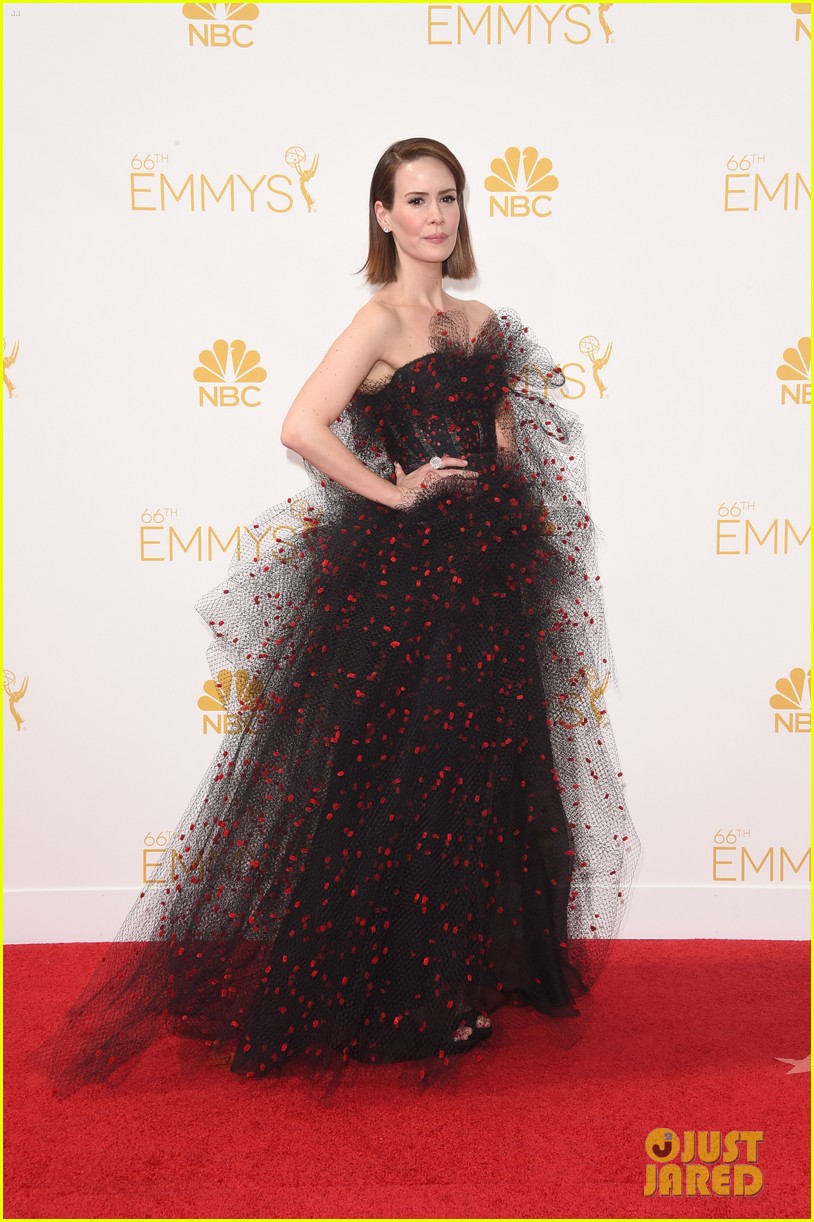 |
| Image source |
One of the few people to wear a traditional fashion big gun, I love this intricately detailed gown. Red and black is a fantastic combination and this is such an effective way of using it. The Gothic net overlay is to die for.
Friday, 15 August 2014
Review: Wolf Hall and Bring Up The Bodies
As I imagine I've mentioned many times before on this blog, Hilary Mantel is my favorite author and Wolf Hall and Bring Up The Bodies are my favourite books. Ever. (Sorry, A Song of Ice and Fire.)
Apparently I’m not the only one who feels that way. Both books have legions of fans and have won the Booker prize. And now both have been adapted for stage by the Royal Shakespeare Company (and screen too - the BBC’s take is currently in production).
The phrase ‘adapted for’ is often enough to strike fear into the heart of book lovers, particularly when the book or series in question is one you really love, but when it’s done well it’s exhilarating to see the characters you love so much brought to life. It’s a risky business though, especially with books as popular and critically acclaimed as Mantel’s. I doubt I’d have been the only one who would've been devastated if these plays hadn't done justice to the books.
Thankfully, this isn't a concern: the plays are utterly, utterly fantastic.
Unusually for me, the first thing I want to rave about is the direction. The source books are long, there’s no getting away from this fact. There’s easily five or six hours of material in each and I was concerned about how this would be condensed into watchable plays. Obviously there are some cuts - mainly to secondary characters and their scenes - but the action is so swiftly paced that these are kept to a minimum. But the action doesn't feel at all rushed though, it just feels urgent. This sense of momentum is helped along by clever stage direction in which characters who are in successive scenes rarely actually leave the stage. They walked to the edge of it, turn round and come back, which sounds daft but actually really works in keeping the play pushing forward. The completely bare ‘concrete’ set helps here too - as there are no changes in scenery, and only the occasional prop, the idea of the characters entering and leaving different rooms or buildings is visually less important. Who cares if they go off stage or not?
With source material as good as these plays have, it would be deeply depressing if they weren't well written. And thankfully they are. Mantel writes excellent, punchy dialogue and much of this is incorporated wholesale into the script, which is uniformly brilliant. The thing that really struck me about the writing though was the difference in tone between Wolf Hall and Bring Up The Bodies. This is evident to an extent in the books but was really emphasised in the plays, with Wolf Hall being almost a knockabout comedy while Bring Up The Bodies something much darker. That’s an oversimplification of course, most of my blogs are, but there was a marked difference and it was worked very effectively, really adding depth to the characters’ development and story.
Excellent writing deserves excellent acting and these plays have the latter in spades. I said in a post earlier this week that My Night With Reg must have one of the best ensemble casts in London and surely Wolf Hall and Bring Up The Bodies, who share one cast, have the other. There’s not a single weak link amongst them, even though most also have the challenge of playing multiple roles (often multiple important roles too: the actor who plays Cardinal Wolsey in both plays also has Archbishop Warham in the first and Sir John Seymour and the jailer at the Tower of London in the second for example!) It feels rude to single any one person out from such an outstanding ensemble, but Nathaniel Parker and Lydia Leonard are a perfect Henry VIII and Anne Boleyn capturing with fantastic effect the arc of their relationship. Parker’s Henry was particularly good, I felt, in Bring Up The Bodies where he’s allowed to show a bigger range of emotion - from besotted to angry via afraid and injured (physically and emotionally).
The one person who it would be rude not to single out, though, is Ben Miles. His Thomas Cromwell is spectacular. It’s a huge part in terms of sheer amount of lines, he’s rarely off stage in the entirety of the almost six hours combined running time, but it’s even huger in terms of the range and depth of character. He plays Cromwell as an East End wide boy type - in no way how I imagined him but, if you think about it, exactly what he was - all quick wit and cunning. In Bring Up The Bodies the character effortlessly develops into something darker and more ruthless. Nothing about his performance feels forced or obvious, it feels natural and completely believable. It’s genuinely scintillating stuff to watch and a performance that demands attention (and surely some awards). I could rave about him for days but I imagine you’d all get bored and wander off. Suffice to say I was impressed, almost Branagh-levels of impressed.
Wolf Hall and Bring Up The Bodies, taken as one piece of work as they should be, is by some distance the most enjoyable, exciting and technically accomplished theatre I've seen in London this year. I would also recommend seeing the two plays in one day as I did because I can only imagine how awful the anticipation of seeing the second one is if you have to wait. I mean I only just lasted the three hours between matinee and evening. It’s really, genuinely great stuff that everyone - familiar with the book or otherwise - should definitely see.
Wednesday, 13 August 2014
Review: My Night With Reg
First things first, this post is about a play. Not anything else you might have been thinking of. Just to clear that up.
Moving on...
My Night With Reg is an early 90s play by British playwright Kevin Elyot. It follows a sextet (great word) of gay men over four years of their collective life and individual lives. Over the course of the play (a short course it should be said, the play is only about 110 minutes long and runs sans interval) it is revealed that all but one of the group - uptight, chaste, sweet Guy - have slept with the titular but absent Reg. There’s flamboyant David, who is Reg’s long term partner; rich kid John, the object of Guy’s unrequited love, who is having a 6 month affair with Reg; odd couple Benny (an alpha male bus driver) and Bernie (“he redefines dull”) who’ve both had one night stands with him; and naive new kid in town Eric who also has a one stand stand with Reg but doesn’t even get to know his name. In the second scene of the play it is revealed that Reg has died of Aids.
This isn’t an ‘Aids play’ in the same way that, say, Angels in America or The Normal Heart is though. It’s not angry and it’s not political. Aids is never directly mentioned once, the power and weight that the word undoubtedly carries is implied through the excellent writing and acting instead. It is a tragic play, certainly, but it’s also a very funny comedy of manners. A tragicomedy that actually works, that rare thing.
This is a phenomenally well crafted play with beautiful dialogue, both funny and tragic. It plays on its themes of love, loss and betrayal subtly but fully. The scenes between Guy and John in particular are fantastic, Guy’s all consuming love for John being both the source of much of the humour and even more of the tragedy of the play. Trying very hard to avoid the dreaded spoilers, there are two deaths in this play and the contrasting ways that John reacts to them is heartbreaking. Although the play is set in the 1980s, the way it deals with its themes so sensitively allows it to still be 100% relevant today - despite it’s love of The Police.
It helps that the cast must surely be one of the finest ensembles on the London stage right now. They are all excellent, but special mention must go to Jonathan Broadbent’s adorable, neurotic Guy and Julian Ovenden’s complicated John. The former in particular could easily become an unbelievable stereotype in less skilled hands, something that would be a disaster for the heart of the play and that Broadbent deftly avoids. Ovenden’s John almost crumples before your eyes over the course of the play, starting off as the cocky, unreliable cad about town but ending as a heartbroken, scared shell with every single one of his insecurities, fears and losses written on his face. He also looks pretty damn good naked, just FYI (if you’re not ok with some fairly prolonged male nudity then this is not the play for you).
If I had to criticise, then the play’s third scene (which I’m trying very hard not to spoil) is fairly predictable once you realise what situation is being played out. That doesn’t diminish its emotional impact for one instant, though. And I did have some issues with the character of Bernie, who is so boring and socially unaware that he does at times feel a bit like a caricature. That said, his moment of real emotion (again, avoiding spoilers) is beautifully written and acted. Minor quibbles aside, this is a really excellent evening of theatre.
I’d urge you to go and see My Night With Reg, but as it’s playing at the tiny Donmar Warehouse the whole run is already inevitably sold out. The Donmar does do seated and standing day tickets though if you have the patience for such things. It’s certainly worth it.
Thursday, 7 August 2014
A day out at Arundel Castle
West Sussex is a lovely part of the world. Really, properly lovely.
I’ve lived here for just over 13 months now - that’s gone crazy quick! - and I love it. It was a big risk for me packing up my life in York (also really, properly lovely by the way) and carting it 250 miles down south but it was absolutely the right move for me. I’m 100% happy here.
That said, I definitely don’t make the most of living here. I have a list of places in I want to visit and explore that’s as long as my arm and just keeps growing. My average week goes thusly: I work 9-5 Monday to Friday, fall asleep on the sofa after doing some yoga most evenings and then spend the weekend either in London or catching up with sleep and housework. I really must try harder.
For once, though, this weekend I managed to cross somewhere off my ‘to visit’ list. And it was one from the very top of that list too - Arundel Castle.
Before we start let’s just get one thing clear: this is not the castle from Frozen. Similar name, different spelling and, crucially, Arundel is actually real. Arundel is a medieval castle dating back to the 11th century and the seat of successive Dukes of Norfolk from the Howard family. Although the original castle is medieval - and some of it still stands - the majority is the result of centuries of renovations, most notably in the Victorian period.
And it is stunning. Approaching the castle from the entrance to the estate is like approaching Hogwarts from Hogsmead.

Look at that. A proper castle! It’s a shame that photography inside the building wasn’t allowed as that was beautiful too. In particular the chapel - the big rectangular bit with huge stained glass windows on the left by the tower in the photo above - is breathtaking. The stained glass is so beautiful (and I went on a gloriously sunny day which really showed it off) and the vaulted ceiling constructed from stripes of white and grey stone made me almost literally drool. I love a good vaulted ceiling, me.
I also neglected to take any photos in the separate FItzalan Chapel - a smaller, less ornate but no less interesting chapel in the grounds of the castle which houses the remains of generations of Howards - because I always feel a bit weird about taking photos of tombs, however beautiful they might be. You’ll see it’s pretty exterior in several of the following shots though.
I did manage to take some photos from the castle’s keep. One of the oldest parts of the building, the 144 rickety stairs are well worth it for the beautiful views.
 |
| The view out to sea, across Arundel town |
I’m not much of a gardener, but the grounds at Arundel are amazing. They’re fantastically varied for a start. Some parts are left almost wild, there’s a traditional rose garden, a fantastic kitchen garden (with the best purple sprouting broccoli I’ve ever seen!) and fascinating glass houses growing everything from chillies to peaches.
 |
| Apples growing in the kitchen garden |
| But the undisputed highlight must be the Collector Earl’s Garden. What looks like a traditional formal garden turns into much more than that on closer inspection of the beautiful, colourful plants and novel display. |
| Apples growing in the kitchen garden |


Impressed with the intricacy of the stone work in all these photos, right? Wrong - none of that is stone, it’s all carved wood. Such a simple, clever and unexpected idea!
One of my favourite parts of the garden were the innovative grottos.

 |
| The inside of this grotto was thatched in moss and dried leaves |

The stunning shell covered one was originally constructed for a performance of A Midsummer Nights Dream as a grotto for Oberon. Isn’t it cool? I love the ‘floating’ crown.
The gardens also offer superb views of Arundel’s beautiful cathedral, which I didn’t have time to visit on this occasion but will definitely go back to check out.


 |
| The cathedral and with the Midsummer Nights Dream grotto in front |
So basically I’m a big fan of Arundel Castle. And the rest of Arundel for that matter. I’d highly recommend a visit - there are direct, reasonably quick trains from London Victoria - and at £18 for the whole castle, grounds and ‘out buildings’ it’s a great value day out.
 Posted with Blogsy
Thursday, 31 July 2014
Book Review: Blood and Beauty - Sarah Dunant
How to get me to read your book step one: put a review on the cover from the New York Times comparing it to Wolf Hall.
How to get me to read your book step two: put it in a Waterstones two for one offer.
This is essentially how I found myself reading Sarah Dunant’s Blood and Beauty this month. The book tells the story of the Borgias - focussing on Rodrigo, Cesare and Lucrezia - over a pretty eventful few years. The story starts with patriarch Rodrigo scheming his way to becoming Pope and tells the story of everything that the family do to preserve and increase their own power and wealth. This includes six tactical marriages (three to Lucrezia), the fathering of four children (half by the Pope), several murders (including the eldest Borgia son, Juan), a bloody war on the Italian states north of Rome waged by Cesare and more political scheming than you can shake a stick at. It’s certainly not an uneventful book.
It’s already easy to see why the book could be compared to Wolf Hall: broadly similar historical period, similar themes, even a similar plot in some ways. But the way both books treat their central figures that really makes the comparison stick. Wolf Hall is of course famous for it’s ‘rehabilitation’ of Thomas Cromwell as a well meaning, family orientated, loyal lieutenant rather than the brutal bully which he is more often portrayed as. In the same way, Blood and Beauty offers a much more rounded and less hysterical portrayal of the Borgias than they usually receive. Lucrezia in particular is a much more human character than usual, though admittedly the book only deals with the early part of her life.
The book definitely benefits from this. I have read some Borgia-based fiction before and, basically, it was just porn and people getting stabbed with very little regard for anything resembling a plot. Not really what I’m looking for in my historical fiction, y’know? Blood and Beauty gives an actual, complete story about actual, complete people and gives them believable motives for what they’re doing, even if they’re motives and actions which are difficult to defend. The characterisation is great throughout.
It’s generally well written too. It’s engaging, pacy and really readable. The 500-odd pages fly by so before you know it you’re half way through. I can’t remember the last time I read a book so fast. That’s not to say it’s perfect though and the comparison to Wolf Hall certainly doesn’t stretch as far as the quality of the writing (but then very few books do). There are times when Dunant’s writing style - third person but clearly representing the viewpoint of a specific character - becomes a bit muddled and on a number of occasions I had to read back to work out who the ‘he’ or ‘she’ she was referring to was. That’s a small point though and certainly didn’t detract from my enjoyment of the book overall.
Whilst Blood and Beauty isn’t a genre defining work in the way that Wolf Hall is, it’s certainly a good example of historical fiction and a really good read. I was glad to see in Dunant’s closing note that there’s a sequel to come. I’ll definitely be picking that up.
Monday, 21 July 2014
Review: Medea
I do love a bit of depressing Greek tragedy, don’t you?
Yes? Good. You should check out Medea at the National then.
The plot of Medea is a textbook Greek tragedy. Medea falls madly in love with Jason (of Argonauts fame), marries him and murders her family to keep him happy. Funnily enough, the latter part doesn't go unnoticed and Medea and Jason flee into exile - Medea bearing Jason two sons in the meantime - eventually ending up in Corinth where Jason promptly leaves his wife for the resident Princess. Medea doesn’t take this fantastically well, and decides that the best way to get revenge on Jason is to murder first his new bride (via a poisoned gown that also takes out the King) and then her own children. Lovely.
As that brief synopsis suggests this is not the play to see if you want a light evening out (in which case try Great Britain since it’s playing in the same building) but it is an excellent production and well worth a little of your time. And it is only a little - the play positively zips along in a shade over 90 minutes (no interval) with excellent direction ensuring that it doesn’t feel rushed. This is a new version of Euripides’ ancient play and the translation and tone are excellent; thoughtful, horrific and frightening plausible. The production looks fantastic too - on a split level stage with Medea’s home and garden (completely with really unsettling empty swings) downstairs, Corinth upstairs where a clever use of slightly opaque glass and lighting means that your view of what’s taking place is always a little obscured.
It’s rare that I’d mention the music in a ‘straight’ play but the score here is a) important and b) really, really good. Written by Will Gregory and Alison Goldfrapp (yes, that one) the score is an electro-infused joy that pulses through the production, driving the action on to its inevitable conclusion. In key scenes the music is so integral that it almost feels like a character in its own right. Seriously, seriously good stuff. I’d love to buy the soundtrack.
The music is also important as it backs a number of dance sequences in the show. Yes, dance sequences. Unlikely, but true. It’s probably overcooking it a bit to say that these sequences constitute interpretive dance but they’re certainly very modern and very otherworldly. At first I thought I didn’t like them but on reflection they definitely contribute to the overall tone of the unnatural that pervades throughout the play and as such are actually quite effective. I doubt it’ll be to everyone’s taste but, after some mulling, it ultimately worked for me.
As high as the production values are, the reason why you should definitely go and see Medea is Helen McCrory’s extraordinary central performance. She is quite simply superb. Medea is not by nature a hugely sympathetic character - although the way she is treated by Jason is shitty, I’m still inclined to think murdering four people is a bit much - McCrory makes you feel for her. She also makes you feel with her, which is much harder. It’s a brilliantly judged and nuanced piece of acting; frighteningly unhinged, coolly calculating and heartbreakingly sad all at once. One of the standout things about the plot of the play is that all other Greek tragic heroines-turned-murderers are given some kind of cosmic or magical justifications for their actions. Medea has none of this and sets out her reasons quite clearly and plainly for the audience to hear and understand. It would be very easy to write Medea off as evil or suffering from some kind of madness (just as it is for Lady Macbeth, with an obviously much stronger case in the end), but McCrory makes it much more difficult to reach these lazy conclusions. Her Medea is a fully realised character and acted impeccably. One of the best pieces of acting I’ve seen for a long time, possibly the best from someone whose surname isn’t Branagh.
Of the rest of the cast it’s only really Danny Sapani’s Jason who gets a considerable amount of stage time and he’s very good too, especially in the post-murder scenes. He is exceptionally good as the angry, grieving husband and father and the rawness of his grief, sometimes howling sometimes quiet, in these scenes is genuinely upsetting. His pre-murders Jason is suitably ambiguous - I’m pretty sure I don’t believe that he’s only acted in his family’s best interests but I wouldn’t put money on it. The Chorus (a large group in this case) are also used frequently, especially in the dance sequences which they manage well, and are generally very good as the conscience of the play. Also, Joyce Barnaby off of Midsomer Murders is in it which is just cool. I bet the Midsomer Parva AmDram Society have never done this one!
Medea actually opens at the National tonight and runs until September 4th (getting the NT Live treatment on its closing night). It’s not an easy watch, but it is a great one and Helen McCrory’s performance is not to be missed. Top stuff.
Subscribe to:
Posts (Atom)