Tuesday, 30 October 2018

Theatre Review: I’m Not Running

Political theatre can be my absolute favourite thing. I am interested in politics, I am interested in theatre, what's not to like?

When political theatre is done badly though, it is pretty much the worst thing in the world. I exaggerate slightly, but you take my point.

A particular strand in political theatre at the moment is Labour Party theatre, a sub-genre which I also rather enjoy. Labour psychodrama is, after all, much more unpredictably entertaining than the Tories (there are only so many plays you can write about awful policies, sleaze and men shagging their secretaries). The latest entry in this ever growing canon is I'm Not Running, a new Labour - New Labour? - play by one of the daddies of political theatre, and lefty political theatre in particularly, David Hare. Sounds good right? There's so much material around for him to work with at the moment! Yeah, don't hold your breath.


I've said it before, but the worst thing a play can be for me is boring. And I'm Not Running is hands down the most boring thing I've seen this year - and possibly longer. It's Allelujah, but without the occasional amusing Yorkshire joke. It sings from exactly the same hymn sheet: politicians are bad, the NHS is great, change is bad yadda yadda yadda. It's only addition is the equally groundbreaking observation that the Labour Party is kind of a huge mess. None of this is new, or news, and none of it is interesting. I don't think I spotted one original thought anywhere in the clunkingly dull script.

Because this is the second problem with I'm Not Running: as well as having nothing to say, it says it so badly. Scenes are endless, which deadens any impact the back and forth in time structure might have had. The plotting is an exercise in convenient and implausible coincidences in which very little actually happens. The characters are either terrible people (I would not vote for any party led by either of the two apparent contenders) or blatant plot devices. The weird, slightly removed from reality but not quite enough, setting is confusing. The jokes aren't funny. The pace is glacial. My friend fell asleep in act two - I was so jealous - and woke up to find a character had randomly died. He leaned over to ask me if she'd been bored to death, and really that just about sums it up.

The production is a little better than its text. Neil Armfield's direction needs to do more to move things along and stop the play feeling like one of those never ending phone calls that you can't end. Ralph Myers' self consciously theatrical set is eye catching, though the visual metaphor is a bit heavy handed (POLITICS IS ALL A CONSTRUCT). The speed with which the set revolves to allow scene changes is a bit excruciating too, though the effect is, eventually, quite clever. The use of video projection to cover these bits is well done. The pre-recorded interviews with the various characters, where the off screen interviewers are voiced by actors including Bill Nighy and Indira Varma, are arguably the play's strongest moments.

It's difficult with plays like this to meaningfully critique the acting. After all, actors can only work with what they're given and really no one is well served here. As lead character Pauline, Sian Brooke is, for me, not a strong lead. She lacks a bit of the presence the part needs. Alex Hassell is particularly poorly served by his character (the Evil Politician, Jack Gould) but does better with what he's given, and does at least raise a few laughs. Liza Sadovy is underused and far more compelling as Pauline's mess of a mother (the one character who is actually well written and quite interesting so naturally she only features in one, relatively short, scene). The ray of light is Joshua McGuire as sunny, neurotic press officer Sandy. His performance is so light and charismatic that it becomes a blessed relief amongst the drudgery. I missed him a lot in the scenes he wasn't in.

I'm Not Running is, for my money, the sort of political theatre that gives both politics and theatre a bad name. However, my entirely scientific poll of the four people I know who've seen it does suggest it has an appreciative audience: people who are like really fucking interested in the internal manoeuvrings of the Labour Party. If that's you then fill your boots. Not you? Take those boots, put them on and run away.

I'm Not Running is at the Lyttelton Theatre at the NT until 31st January.

I paid £32 (100% not worth it) to sit in H31 in the circle for this one. 

Saturday, 27 October 2018

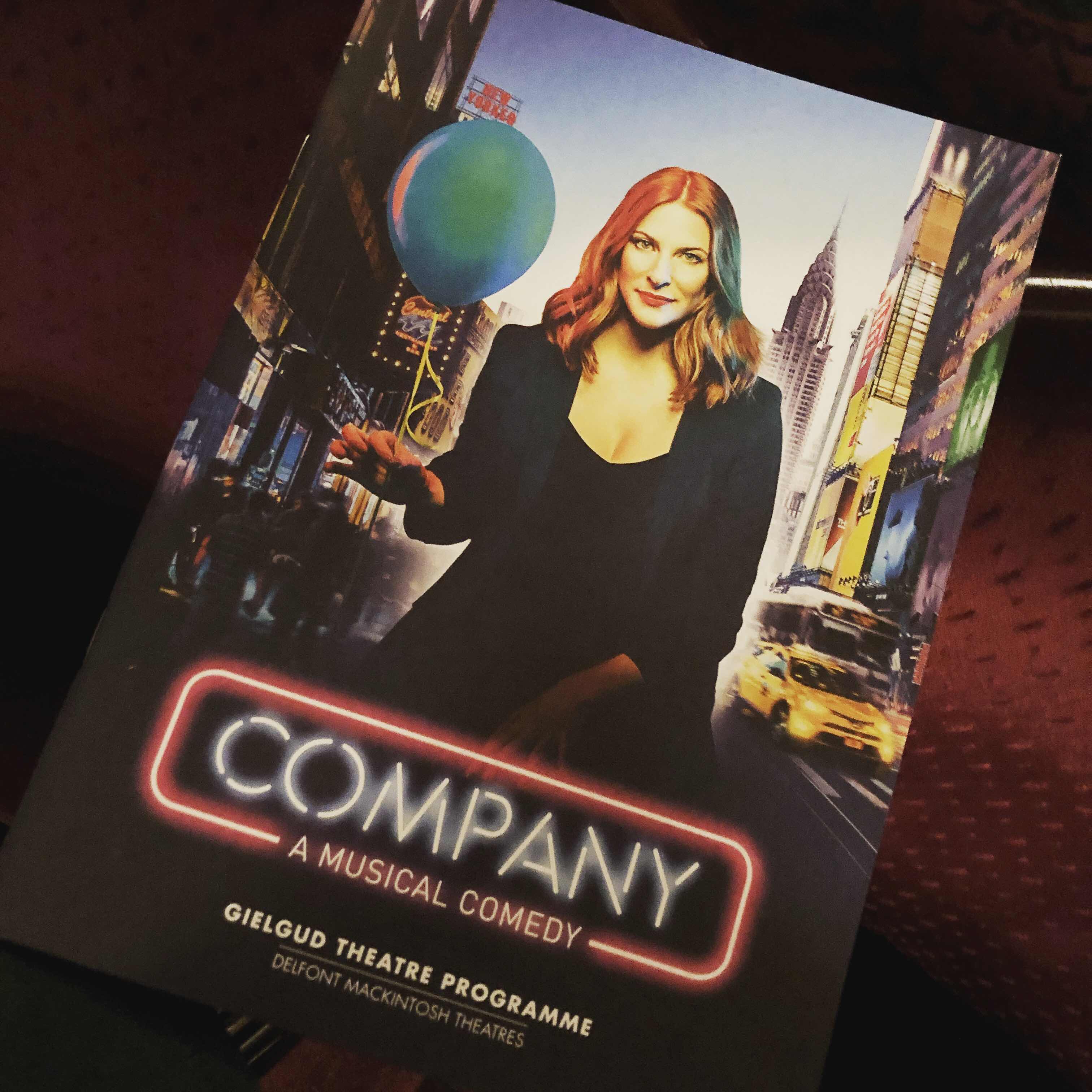
Theatre Review: Company

Where were you when you found out Meghan Markle was pregnant? Me, I was on a train - when am I not? - and I found out thanks to the man sitting opposite me's delightful observation that it was a good thing she and Prince Harry had got on with things because "she's knocking on a bit". Logging on to Twitter, never a good idea, the coverage would have made you think that Meghan, at 37, was basically dead. The number of 'how difficult is it to conceive at 37?' articles that crossed my horizons in the next few days was ridiculous.

The pressure on single women in our thirties, of which I am one, to do the marriage and babies thing - or explain in detail, repeatedly, and to literally anyone who might ask, why we're not - is colossal. And of course, for thirtysomething women who do want to do the marriage and babies thing, of which I am definitely not one, the pressures of time and biology are even colossal-er. On the other side of the gender coin, what pressures does a thirtysomething single man face? Struggling to think of any right now. 


All of the above is my way of pointing out why Marianne Elliott's new and updated production of Stephen Sondheim's Company is so utterly necessary. And I use the word necessary very deliberately. As I'm sure you know, unless you've been living under some kind of rock, the big update here is to gender swap the lead role. Hence, the show is now anchored by Bobbie, a 35 year old single woman surrounded by married friends desperate to get her to settle down. Company isn't a show I knew very well before this production, so all I can say about this and the other accompanying gender swaps (including the introduction of a same sex couple) is that I cannot imagine it the other way around. In 2018, who cares about a single 35 year old man? Why should we invest anything in that guy?

Having now properly discovered it, I can safely say that I love this show. I think it may be my favourite Sondheim; so complex, so unashamedly grown up, so funny and demanding the absolute best of its performers and creatives.The music and lyrics are just brilliant. Name me a better (and for me, in this production, more relatable) musical song than Being Alive. I'll wait... George Furth's book is a joy. Funny and sad and, with the twenty first century updates, utterly compellingly relevant. And it's very rare to see a show with so many main characters, all of whom are actually properly developed and rounded.

This production is something truly special too, and not just because of the updates. Director Marianne Elliott is an actual genius and Company is as good as anything else she's ever done, if not better. It's got such life and heart. Her conception of the story as a modern Alice in Wonderland (after all, much of it is happening in Bobbie's head) is wonderful. She completely gets the story she's telling too, as evidenced not just in all the gender swapping but also in the way it's told, the way everyone else treats and talks to Bobbie. Possibly my favourite scene is where a group of married, middle aged men sing about how worried they are about Bobbie in her bedroom whilst an astonishingly attractive cabin crew chap goes down on her. As visual metaphors for being a single woman in your thirties go, they don't come much better.

Bunny Christie's design is, reliably, superb. Everything is done in a series of boxes to separate the various couples, and Bobbie, and to elevate the down the rabbit hole vibe. It looks so cool, especially with Neil Austin's gorgeous neon-accented lighting, and it technically works so well too. Liam Steele's choreography is witty and eye-catching and unmistakably modern. And, for I think the first time ever, I want to shout out to the casting directors. Alastair Coomer and Charlotte Smith have done an amazing job assembling a team of actors who are not just super talented but 100% right for their parts. There are some casting decisions here that made me raise an eyebrow initially (Mel Giedroyc primarily to be honest) but in every case the exactly right person is in the exactly right role.

And Jesus H Christ what a cast this has led to. There is an absolutely insane amount of talent on show on this stage and the entire cast is pretty much faultless. Without question, this is the best cast in London right now by, like, a lot. Rosalie Craig is a sublime Bobbie, exactly the right balance of vulnerability and sass, and with a voice to absolutely die for. Her Being Alive gave me literal goosebumps. Patti LuPone, queen of fucking everything, is exactly as good as you want her to be and then a little bit more, doing enjoyably bitchy and actually just a bitch with equal icon-ness. In a show in which everything is A Moment, Jonathan Bailey delivers the Moment of the night as (gender swapped) Jamie with a mind bendingly good Getting Married Today, my personal highlight of the whole show. Richard Fleeshman is an adorable and surprisingly touching (gender swapped - thank god because as a female part this would have seemed just awful in 2018) Andy. Mel Giedroyc and Gavin Spokes are a lovable but complex joy as Sarah and Harry. I could go on and on and on. Everyone on that stage is amazing.

This production of Company is stunning. More than that, it's important. It's, genuinely, necessary. Theatrically, it feels like a proper moment; event theatre at it's very best. Get your ticket immediately.

Company is at the Gielgud Theatre until 30th March.

I saw this one in preview and paid £25 to sit in G14 in the Grand Circle (which is actually a great seat for the price).

Thursday, 25 October 2018

Theatre Review: A Very Very Very Dark Matter

'Well that was bonkers' is not one of my usual post-show opinions. Variations on good, bad and boring feature often, but bonkers? Not so much. My bonkers quota is sadly unfilled.

Or at least it was. Because having seen The Bridge theatre's latest, Martin McDonagh's A Very Very Very Dark Matter, my bonkers quota is through the roof. Also my batshit mental quota. And my what the fuck did I just see quota.


I'm not even going to attempt to explain the plot, save to say that it largely revolves around the idea that Hans Christian Andersen didn't write any of his stories, keeping a lame 'pygmy' from the Congo in a box in his attic to do all the work for him. You see? And that's the bit that makes sense. Various other strands involve time travel and magical gypsies giving out machine gun accordions. Not making any of that up. At heart, A VVV Dark Matter is a bleak satire on colonialism and race, dressed up as a distinctly adult, and did I mention bonkers, fairy tale. However, I think it's fair to say that the bonkers plot is not the strength of this piece, though as unlikely as it may seem it does just about all hang together. 

For me the strength lies instead in the bleak imagination, weirdness and flights of bizarre fancy that McDonagh conjures in his script. And, most of all, the blackest of black humour he uses. I saw this show in an early preview and it surprises me 0% that a lot of subsequent audiences and critics alike have found it offensive. As it happens I disagree, but there's no question that the language and concepts used here are, to put it extremely mildly, a bit fruity. There is some joyous swearing. Like, the best swearing you'll find in theatre at the moment. There is brilliant, no blushes spared satire of the attitudes towards race that colonialism engendered and indeed those that are still prevalent today (an interpretation that many will not agree with, I suspect). The script revels in its bleakness and is endlessly quotable ('was he Belgian?' 'Well he had dark hair and a huge inferiority complex'). It's not so much close to the knuckle as bypassing the knuckle altogether and going straight for the balls. It is unquestionably not for everyone, but it is equally unquestionably definitely for me. 

The Bridge stages it wonderfully too. Director Matthew Dunster's production is wicked: quick, confident and sure footed. You get the sense he knows that this will be theatrical Marmite and so decides to attack it with everything, possibly including the kitchen sink. I admire his cojones. Everything looks, feels and sounds gloriously spooky thanks to Anna Fleischle's brilliantly bonkers design, combined with Philip Gladwell's grimy lighting and James Maloney's unsettling music. Tom Waits (yes, that Tom Waits) provides a brilliant recorded narration. It's all supremely atmospheric, a grown up haunted house. The Bridge doing what it does best, creatively, whatever you think of the play.


The cast is a dream too, the sort of thing that only someone with McDonagh's artistic heft and eclectic tastes could assemble. American newcomer Johnetta Eula'Mae Ackles is brilliant as Ogechi (the aforementioned 'pygmy'),  all punch and sass and never a victim. Phil Daniels is perfectly cast as a foul mouthed - and utterly scene stealing - Charles Darwin Dickens, aided and abetted by his equally strident wife, played with glee by Elizabeth Berrington. The Andersen-DarwinDickens dining room scenes are the most I've laughed in a theatre for a long ass time, often due to Berrington's deadpan delivery ('you're shitting me' has never sounded so glorious). The star draw here though is the great Jim Broadbent who is on majestic form as Andersen himself. He is dripping with charisma, evilness and stupidity but amazingly good fun. His performance is gleeful and hilarious; and worth the price of a ticket alone. 

You're either going to love A Very Very Very Dark Matter or loathe it. This is not a show you can be neutral about. Either way, it's certainly provocative and I would say that you should see it and judge for yourself rather than relying on the critics (or, you know, me). For what it's worth, I loved it. Go with an open mind and a high offense threshold and I think you will too.

A Very Very Very Dark Matter is at The Bridge until 6th January. 

I saw this show in preview and sat in seat C41 in level three, having paid £15. I've sat in this row of seats, which is the very very very back row, loads of times now and it represents some of the best value in theatreland for my money. Sightlines are brilliant. 

Monday, 15 October 2018

Theatre Review: Hogarth’s Progress

I like a two show day. They’re efficient, lots of play for one train ticket, even if the risks of a numb arse and some knotty lower back issues are high.

The latest addition to my collection of these is Hogarth’s Progress at the Rose Theatre in Kingston (my first visit: a nice, modern venue, great cafe, slightly weird auditorium, no armrests). Not strictly a double bill in the sense of a play and an immediate sequel, Hogarth’s Progress consists of two plays by Nick Dear: The Art of Success, thirty years old, and a new companion piece, The Taste of the Town, set thirty years later. Both tell the story of William Hogarth, artist and satirist, his wife Jane and a fluctuating cast of friends and enemies. Presented in rep - only one actor gets away with not being in both - it’s an interesting take on a two show day. 


It’s also for me very much a double bill of two halves, so to speak. The Art of Success was not for me. I found it muddled and puerile, trying too hard to shock (and failing). It doesn’t feel like it knows what it wants to be. Is it a history play? A morality play? A satire? A musing on the nature of art? It tries to do all these things and almost inevitably succeeds at doing none of them. I found it quite boring and really not very funny.

The Taste of the Town on the other hand I really enjoyed. It’s a clear headed and focused play about loss, regret and death. It’s much more punchy and far funnier. It’s still sweary and brash but the stronger plot and thematic coherence gives the vulgarity meaning and context. It’s a far, far stronger piece of writing. And I laughed a lot.

What I would say, though, is even though I didn’t enjoy the first play that much it’s still really interesting to see them both together. Not only for the way it fills out the understanding of Hogarth’s story but also, and possibly more so, for the way it allows you an insight into the development of Dear’s writing. I’ve said it already, but this is a really fun take on the double bill.

The production of both shows is strong too. Anthony Banks’ direction is solid and his storytelling is crystal clear (even if I could have stood things being a bit quicker, particularly in the first play). The use of the weirdly cavernous Rose space with it’s huge, slightly industrial, stage is really good and everything looks sort of grimly gorgeous. Andrew D Edwards’ design is really effective, I loved the massive screen that formed 99% of the set and backdrop, and Douglas O’Connell’s projection makes it even better. There’s some lovely use of lighting as scenery from lighting designer James Whiteside too.

The cast is also really strong. As previously mentioned, all but one of them have different parts in the two plays. The one who escapes is Keith Allen, who makes up for having the afternoon off with a fantastically good fun older Hogarth in the second play. As ever, he is essentially playing himself but it totally works here. Amongst the harder working cast member (soz Keith) Mark Umbers gets the pick of the parts with Robert Walpole and David Garrick on his to do list. He plays both of them with great poise and his swaggering Garrick in the second play is a particular highlight. The reliably excellent Ian Hallard is, reliably, excellent (haven’t used that line in a while) as a genuinely disgusting toff in play one and a mischievously bitchy Horace Walpole in play two.

There are some fantastic parts for the actresses in the cast too, still a rarer sentence than it should be. Jasmine Jones is a ray of light (well after a fashion) as the murderous murderess Sarah Sprackling in play one. Susannah Harker and Sylvestra Le Touzel sparkle in play two as an older Jane Hogarth and her formidable mother respectively.

For all that this is an uneven double bill, it does work well. It looks great, the cast are strong and it’s an interesting experiment in the use of a two show day. If you only have time to see one, I would undoubtedly recommend The Taste of the Town - for my money the only one to merit a standalone viewing.

Hogarth’s Progress is at The Rose Kingston 
until 21st October. There are upcoming two show days on both the 20th and the 21st.

My seat for this one was B10 in the stalls for £17.50 (a discount because my friend’s cousin is the producer there, though the discount wasn’t linked to this post in any way).

Friday, 12 October 2018

Theatre Review: Cock

Every writer has their thing, or things in some cases. The random stuff and tiny details that they’re really good at. Like the Pinter Pause but less annoying.

Mike Bartlett has two I think: terrible dinner parties and just god awful men. He is really fucking good at writing both of these things. I do mean this as a compliment, even if it may not sound like one.

Both of these things are in evidence in Cock (stop snickering at the back), an early Bartlett currently being revived for the first time as part of the Chichester Festival Theatre season. Staged in the small Minerva theatre, it tells the story of John a hitherto definitively gay man with a partner he claims to love who also claims to fall in love with a woman. With him unable to decide between the two, a classic Bartlett dinner party from hell is arranged to basically pit them off against each other.


To be frank, this isn’t Bartlett’s best play, characteristic tropes aside. It’s discussion of sexuality and labels (John refuses to label himself as bisexual and is terrified of disowning the ‘gay’ label he’s felt is part of him for so long) is undoubtedly timely, but in a weird way the play suffers for it in that there are more insightful and sensitive pieces, fictional and not, easily available to anyone with access to the internet. The play was originally staged at The Royal Court and it does seem to fulfil my prejudice of what a Royal Court play is: not as clever as it thinks it is. See also: Bartlett’s insistence that his text is performed with no set, no props and no ‘mime’ (so when a character asks someone to pass the wine no one moves, for example) which works I would say 50% of the time, the other 50% just being distracting. (The no mime sex scene works oddly well though - just two people looking at each other, smiling and making happy sounds. It’s weirdly touching.)

There’s also an uncomfortable whiff of casual sexism running through parts of the play. I hated the constant repetition of the idea that one of the main appeals of the female love interest was babies. Like leave her womb out of it dickhead. The jokes about women looking manly (which seems to translate as tall and with big hands) wear quite thin after a while too, especially in a play otherwise so concerned with how arbitrary labels are. The female character generally feels underwritten. Though I don’t think it’s intentional, it feels more careless than anything, it’s still not really ok, for my money.

I also have an issue with the characterisation, one that I have had with Bartlett stuff before, in that every character in this play is some degree of awful. John, the central character, is the absolute worst. Borrowing from the Bartlett TV canon, he is Simon Foster but more manipulative; Duncan from Press but more of a twat. That bad. Which is sort of fine to an extent, except that we’re supposed to believe that two other human beings love him enough to fight over him. And that really stretches my willing suspension of disbelief to its limit.

All of that said though, Cock is an entertaining enough play. After all, no one writes conflict between terrible people better than Mike Bartlett. The action is non-stop. The dialogue is joyfully caustic, punchy and sad when it needs to be. The audience is never not engaged. It is very, very funny. I enjoyed it, even as I was irritated and underwhelmed by it.

A lot of that is down to a characteristically strong Chichester production. Helmed by Chichester newbie Kate Hewitt, the production is pacy and robust. She brings out the naturalism of the play nicely and balances some big performances really well. To be designer of a play which explicitly has no set and no props must be a fairly weird gig, but Georgia Lowe’s MMA ring of a design is a knockout (do they have knockouts in MMA? I don’t know). Guy Hoare’s red and white neon lighting is the perfectly harsh accompaniment. This play is written as a fight, and this production works literally and super effectively with that idea.

The cast of four work their arses off to absolutely sell it too. In a show performed in a small, bare room where all you can do is talk and move a bit, there’s nowhere to hide and the four actors assembled here fully embrace that and chuck themselves in without fear. Luke Thallon is as great a lead as his character, awful John, is terrible a human being. That I sympathised with John at all is 99% down to him. He brings a wonderfully understated physicality to the role, simpering smiles, quivering emotion and all. He is endlessly watchable and properly good when ragey. Matthew Needham is a perfect counterpoint to him as male love interest M (don’t even get me started). He gets the bulk of the comedy and relishes it in a catty, hyperactive but ultimately very lonely performance. They’re a supremely entertaining double act. Rounding out the quartet, Isabella Laughland is a ballsy and beguiling woman love interest (called only W, obviously) and, though his part is largely superfluous to any of the plot, Simon Chandler as M’s father F (seriously) does a lively and pleasingly oily job.

Overall, I was disappointed with Cock (not the first time I’ve said that). It’s by no means classic Mike Bartlett, even if it does have the key features, and doesn’t have as much to say as I expected. That said, it’s still great fun and, for connoisseurs of supreme social awkwardness in particular, a decently entertaining hour and a half. The cast and the production do much to elevate it too.

Cock is in the Minerva at Chichester until 27th October.

I sat in seat A2 and paid £28 for my ticket.

Thursday, 27 September 2018

Theatre Review: Antony and Cleopatra

Big, lush, classic Shakespeare isn't something I've seen too much of recently. 

Don't get me wrong, this isn't a value judgement. I'm not one of those people who thinks any 'type' of Shakespeare production is better than any other. I cannot abide modern dress or traditional dress bores or people who spend their entire evenings apparently with a fucking metronome out to check that the pentameter is in fact iambic. 

I just like good Shakespeare, you know? Shakespeare productions that tell the story and have something to say and, bluntly, aren't boring or pretentious nonsense. Something which is actually quite hard to find.

One of the places where it has been notably hard to find of late is the National Theatre. Remember Macbeth? I mean, ugh. However, redemption is at hand. Enter Simon Godwin - one of my absolute favourite directors - accompanied by Ralph Fiennes (!), Sophie Okonedo (!!) and a copy of Antony and Cleopatra (!!!) 


I mean, need I say more? Do I even have to write this post? A top flight director, a classic play and a cast that is an absolute dream. There is so little to go wrong here, and so little does. This is a solid, classy and huge production that ticks pretty much all the boxes. 

Antony and Cleopatra isn't a play I knew before and I wouldn't say it's now become one of my favourites. But it's an exciting one nonetheless; the mixture of politics and personal is super compelling. And of course there are some classic Shakespeare lines to chew on. I confess that I'd forgotten that 'age cannot wither her' was Shakespeare and not an original line from Mamma Mia and I'm not ashamed to admit that.

Simon Godwin's production is absolutely top drawer. It's fair to say there's not much that's massively innovative on display but it doesn't much matter. Because what is on display is so utterly sure footed, classy and beautifully done that you absolutely cannot argue with it. Godwin's direction is bang on. The production never rushes but also never feels the three and a half hours that it is. It's unashamedly big and sweeping but can do small and intimate too. Hildegard Bechtler's design, making full use of the Olivier stage's glorious drum, is a cracker. Pitched somewhere between Keeping Up with the Kardashians and peak 1970s - which is actually the best combination for the central characters if you think about it - I want to live in the set. Evie Gurney's costumes accent it perfectly: so much print and so much draping. Tim Lutkin's lighting is beautiful and stark. Jonathan Goddard and Shelley Maxwell's movement is really clever. It's a perfectly wrought production for the vast Olivier. It uses the stage so well.

As do the actors. There's something thrilling about seeing actors of the calibre of Fiennes and Okonedo on a stage as big - metaphorically and literally - as the Olivier. It sort of goes without saying that they're both great. Fiennes is a classic Shakespearean and his style, which has a certain formality to it, works for the meaty, military parts like Mark Antony. He has a great sense of mischief too, his reaction to his failed suicide attempt is a surprising and joyously unexpected laugh out loud moment. (To be clear, though, David Morrissey is still my Antony.) Okonedo revels in the high camp of Cleopatra and is as majestic and Queenly as required and then some. The chemistry, based to a huge degree on shared mischief, between her and Fiennes is supremely watchable. And she handles a snake with incredible chutzpah (as the only person in the centre of the theatre blogger-animal welfare charity staffer venn diagram though, I have to ask whether a real snake was actually necessary). 

There's much joy to be found away from the central characters too. Tim McMullan is a perfect Enobarbus, wise and wry and, ultimately, rather tragic. McMullan is superb in everything he does (even in Common, which was appalling) and here I reckon he might be the pick of the bunch. Which is going some. Credit too to the younger cast, in particular Fisayo Akinade who does fantastic things with the relatively uninteresting part of Eros. His comic timing is excellent. Gloria Obianyo as Charmian is great too, dripping charisma and sass. She dealt with an errant snake with incredible poise and calmness the night I saw the show (again, a real snake?) 

Reservations about the snake aside, there is really very little to fault in this Antony and Cleopatra. It's lush, epic and a piece of sheer class. Better than that, it's that rare theatrical beast: a god production in the Olivier. Praise be!

Antony and Cleopatra plays in the Olivier at the NT on selected dates until 19th January. Tickets are not plentiful, but it does get the NTLive treatment on the 6th December.

I sat in seat F1 in the stalls for this show, which I saw in preview. I paid £29 and I will fight anyone who tells me that that isn't supreme value for money. 

Saturday, 22 September 2018

Theatre Review: An Adventure

Of all the Artistic Directors jumping on the theatre leadership job merry go round that London seems to be going through at the moment, the only one I can honestly muster strong feelings about is Madani Younis leaving The Bush.

I’m a relative newcomer to The Bush and haven’t known it under anyone else’s stewardship but everything about it’s vibe under Younis is something I love. Not least it’s extraordinarily inclusive, often quite brave programming - the best in London as far as I’m concerned. As well as the diversity of voices The Bush allows to be heard, I particularly love the fact that it gives new and newish writers a platform.

Vinay Patel probably falls into the newish category. I mean his debut play may only have been staged four years ago but he’s also won an RTS award and been nominated for a bunch of Baftas (for Murdered By My Father - which is great and you should watch btw) in the meantime. Oh, and he’s writing for the new series Doctor Who. So yeah. There’s that. 


An Adventure perhaps has some things in common with the current good Doctor. Set over the course of 60 years plus, An Adventure tells the story of Rasik and Jyoti from their meeting and early romance as youngsters in Ahmedabad to their lives as immigrants in London, via an encounter with the Mau Mau rebellion in Nairobi, and back again (time travel sans Tardis). It’s a great piece of writing for me on two levels. First of all, it tells a story of which I was pretty shamefully ignorant: that of the immigrant experience of first generation Asians (both to Britain and elsewhere). It’s fantastic to see that story on the stage, fullstop. And, as I suspect is the intention, it makes a fantastic companion piece to The Bush’s production of Leave Taking. That would’ve been a hell of a two show day. 

On a deeper level though it serves as a timely reminder of the universality of some aspects of the human condition: the importance of family, the desire to find somewhere where you truly belong even if you have to fight for it, the fear of aging and of a life wasted, the difficulties of love, the fight for freedom, the depressing inevitability of discrimination. It’s a surprisingly political play, no bad thing, and a funny one too both in a laugh out loud and laugh awkwardly sort of way. The characterisation is great, the small cast of characters all richly drawn and sympathetic even as their views oppose and diverge. For my money, at two hours forty five (plus intervals) it is a trifle too long, though to what extent this view is influenced by the fact that The Bush’s seats don’t have armrests I can’t honestly say (I love armrests, it makes me sad that so many theatres don’t feel the same way).

Perhaps the best thing about An Adventure, and the thing that made me look forward to Patel’s foray into the Who-niverse, is the strength of Jyoti as the central character. This is very much her play, and the focus on the female character of the couple when this is so often not the case in real life (as the play explicitly acknowledges) is touching and dramatically deft. Jyoti is an absolutely kick ass character, spunky and proactive and clever and funny. She is political - and how rare to see a play where a female character is allowed to be. She just sparkles on the page and the stage. The latter is certainly down in no small part to the actress who plays her, Anjana Vasan. She’s absolutely excellent, a huge highlight of the production and genuinely luminous (not a concept I’ve really understood when applied to an actor before but with her I 100% get it). 

She has fantastic support from her Rasik, Shubham Saraf. Rasik is an utterly adorable naif as the play begins but becomes something much more complicated and rounded as it progresses. Saraf brings out every facet with charm and determination. A deeply watchable and moving performance. The play is at its weakest in the third, present day, act purely because Saraf and Vasan no longer play Rasik and Jyoti. No disrespect intended to the older cast members, but they just don’t quite have the chemistry and sparkle of these two. 

The production looks and sounds lush - the incidental music alone is worthy of several paragraphs of love - but I really want to particularly praise the direction here, because it’s by Madani Younis and I want to make the most of him. Despite the resultant back pain, I loved his relaxed, expansive almost louche vibe. He has every faith in this play, as well he should, and the story and this just shines through. It’s a real joy. The Bush really will miss him so much. 

An Adventure is a really lovely thing. Great writing, beautifully performed, artfully directed and an excuse to bop around to Brimful of Asha in the interval. Who needs more?

An Adventure is at The Bush until 20th October. 

My seat for this was C1 in block B and I paid a measly £10 for it thanks to The Bush’s Count Me In scheme.