Saturday, 22 September 2018

Theatre Review: An Adventure

Of all the Artistic Directors jumping on the theatre leadership job merry go round that London seems to be going through at the moment, the only one I can honestly muster strong feelings about is Madani Younis leaving The Bush.

I’m a relative newcomer to The Bush and haven’t known it under anyone else’s stewardship but everything about it’s vibe under Younis is something I love. Not least it’s extraordinarily inclusive, often quite brave programming - the best in London as far as I’m concerned. As well as the diversity of voices The Bush allows to be heard, I particularly love the fact that it gives new and newish writers a platform.

Vinay Patel probably falls into the newish category. I mean his debut play may only have been staged four years ago but he’s also won an RTS award and been nominated for a bunch of Baftas (for Murdered By My Father - which is great and you should watch btw) in the meantime. Oh, and he’s writing for the new series Doctor Who. So yeah. There’s that. 


An Adventure perhaps has some things in common with the current good Doctor. Set over the course of 60 years plus, An Adventure tells the story of Rasik and Jyoti from their meeting and early romance as youngsters in Ahmedabad to their lives as immigrants in London, via an encounter with the Mau Mau rebellion in Nairobi, and back again (time travel sans Tardis). It’s a great piece of writing for me on two levels. First of all, it tells a story of which I was pretty shamefully ignorant: that of the immigrant experience of first generation Asians (both to Britain and elsewhere). It’s fantastic to see that story on the stage, fullstop. And, as I suspect is the intention, it makes a fantastic companion piece to The Bush’s production of Leave Taking. That would’ve been a hell of a two show day. 

On a deeper level though it serves as a timely reminder of the universality of some aspects of the human condition: the importance of family, the desire to find somewhere where you truly belong even if you have to fight for it, the fear of aging and of a life wasted, the difficulties of love, the fight for freedom, the depressing inevitability of discrimination. It’s a surprisingly political play, no bad thing, and a funny one too both in a laugh out loud and laugh awkwardly sort of way. The characterisation is great, the small cast of characters all richly drawn and sympathetic even as their views oppose and diverge. For my money, at two hours forty five (plus intervals) it is a trifle too long, though to what extent this view is influenced by the fact that The Bush’s seats don’t have armrests I can’t honestly say (I love armrests, it makes me sad that so many theatres don’t feel the same way).

Perhaps the best thing about An Adventure, and the thing that made me look forward to Patel’s foray into the Who-niverse, is the strength of Jyoti as the central character. This is very much her play, and the focus on the female character of the couple when this is so often not the case in real life (as the play explicitly acknowledges) is touching and dramatically deft. Jyoti is an absolutely kick ass character, spunky and proactive and clever and funny. She is political - and how rare to see a play where a female character is allowed to be. She just sparkles on the page and the stage. The latter is certainly down in no small part to the actress who plays her, Anjana Vasan. She’s absolutely excellent, a huge highlight of the production and genuinely luminous (not a concept I’ve really understood when applied to an actor before but with her I 100% get it). 

She has fantastic support from her Rasik, Shubham Saraf. Rasik is an utterly adorable naif as the play begins but becomes something much more complicated and rounded as it progresses. Saraf brings out every facet with charm and determination. A deeply watchable and moving performance. The play is at its weakest in the third, present day, act purely because Saraf and Vasan no longer play Rasik and Jyoti. No disrespect intended to the older cast members, but they just don’t quite have the chemistry and sparkle of these two. 

The production looks and sounds lush - the incidental music alone is worthy of several paragraphs of love - but I really want to particularly praise the direction here, because it’s by Madani Younis and I want to make the most of him. Despite the resultant back pain, I loved his relaxed, expansive almost louche vibe. He has every faith in this play, as well he should, and the story and this just shines through. It’s a real joy. The Bush really will miss him so much. 

An Adventure is a really lovely thing. Great writing, beautifully performed, artfully directed and an excuse to bop around to Brimful of Asha in the interval. Who needs more?

An Adventure is at The Bush until 20th October. 

My seat for this was C1 in block B and I paid a measly £10 for it thanks to The Bush’s Count Me In scheme. 

Sunday, 16 September 2018

Theatre Not Review: Sylvia

Reader, I have a dilemma.

I want to review The Old Vic’s latest show, hip hop/soul/funk Suffragette musical Sylvia, for you. But there’s a problem. As I’m sure most readers of a blog like mine will know, this production has not had an easy start in life  The performance I was originally going to see was cancelled due to the illness of its leading lady (still not returned). The one that I did see instead (shout out to the OV box office who were absolute superstars with the rebooking) was therefore not a finished article. And this isn’t my judgement by the way. It’s the judgement of The Old Vic, whose front of house staff were handing out notes before the show apologising that it was “considerably longer and in a more raw state than the creative team at The Old Vic would ever have planned.” Any blogger with even an ounce of integrity wouldn’t review a performance thus billed.

On the other hand, for all the very evident issues and the fact it ran to a bum numbing three and a quarter hours, I LOVED THIS SHOW SO MUCH AND I HAVE A LOT OF FEELINGS ABOUT IT THAT I NEED TO DISCUSS. 


Or, to put it more sanely: despite everything, Sylvia is one of the best shows I’ve seen this year. So therefore what follows isn’t a review, not really (I’m not going to tell you what the very evident issues were, for a start). It’s just some thoughts, gut reaction, rendered into something slightly more user friendly than a Twitter thread. It’s the return of the bullet points y’all. 
  • One of the reason The OV give for the show not being quite where they’d like it to be is that it’s evolved from a dance show into a full blooded musical and Jesus H Christ thank god it has. The music, written by Josh Cohen and DJ Walde with punchy as fuck lyrics by Director/Choreographer/BAMF Kate Prince, is an absolute blast. A riotous blend of hip hop, soul, funk, grime, dance hall and myriad other things, it is just soul lifting to hear. There are some air punchingly good samples - I almost rushed the stage when a prime ministerial entrance was heralded by a few bars of Dizzee Rascal’s Fix Up Look Sharp. I demand a cast album and I demand it now.
  • Kate Prince and Priya Parmar’s book is also kick ass. The story they’ve chosen to tell, of Sylvia Pankhurst rather than the Suffragettes in general, is a clever choice. It’s not a story that I suspect most people know and it’s incredibly interesting and relevant in terms of the focus it puts not just on women’s rights but on poorer women’s rights. Intersectional Feminism: The Musical. 
  • The Pankhurst family were much more of a hot mess than I realised. Just saying.
  • Prince’s choreography is brilliant. It’s like watching the best rave you’ve ever seen (and, I rather suspect, in a different theatre it would be an actual rave - I would chop off a limb to see this at The Bush).
  • Ben Stone’s punchy but simple design with Natasha Chivers’ full on party lighting is a sight to behold.
  • This cast is everything. I don’t think I’ve seen a group of performers so committed to having fun with a piece on the stage ever. And they just seem to love each other. You can feel them willing each other to do well. I found this inordinately moving. It’s such a team effort and I absolutely loved it for that. 
  • Individuals? Well there’s no one in the business/world with a better voice than Beverley Knight and she is majestic here in a pretty unsympathetic part (which surprised me a bit). Delroy Atkinson’s Winston Churchill is the best Winston Churchill. Jade Hackett basically steals the whole damn show and I have never loved Winston Churchill’s mum more. And huge props to new leading lady Maria Omakinwa who absolutely kills as Sylvia herself in probably the most difficult circumstances a leading lady could face. She’ll go on to gigantic things I have no doubt.
  • I’ve never seen a curtain call like Sylvia’s at The Old Vic (or many other places for that matter). It’s just like five minutes of absolute joy, both from the cast on stage basically having a small party and from the audience who promptly went nuts as soon as the lights went down on the final line. Old Vic audiences are not, in my experience, renowned for their going nuts abilities. This show has really got something.
  • There must be a future for this show beyond its ridiculously short OV run. There just must be. If (when) there’s an extension or a transfer I will see it as many times as my bank balance will permit.
  • If you can, see Sylvia and Misty (currently at The Trafalgar Studios) as a two show day for a small and hopeful glimpse of what British theatre can be when everyone decides to br brave.
  • Seriously though: cast album. Cast album now
Sylvia is at The Old Vic until 22nd September (!!) Grab the last remaining tickets whilst you can.

I paid £10 for a seat in the top circle for this show. However, because my ticket had to be reallocated I ended up sitting in D4 in the dress circle, which would usually cost £28. 

Thursday, 13 September 2018

Theatre Review: Dust

One of the laws of theatre is that the fringe shows that I really want to see but miss and the shows that get a second/bigger/West End run never, ever overlap. Ever. To the extent that I've begun to wonder whether my good opinion jinxes them in some way. 

Thankfully, and for once, I have an exception to this rule. Dust, written and performed by the insanely talented Milly Thomas, is a show I remember hearing about at the Edinburgh Fringe a couple of years ago (I have yet to do an Fringe so didn't see it). It then transferred to the Soho Theatre, where I missed it for various (presumably work related) reasons which now escape me. So when it reappeared once again at the Trafalgar Studios I finally got my shit together and mooched along. And, at the risk of slipping into horribly hackneyed writing, I am exceptionally glad I did. 


Dust is not an easy play; in fact it is more of a trigger warning made flesh. Based on Thomas' experiences of depression, it tells the story of Alice, who's recently take her own life and whose post-body form - call it what you will - now gets to watch the impact her death has on those around her. She also lets us in on some of the formative moments that led her to that decision. Cheery stuff! 

And yet it actually is quite funny. Pitch blackly funny, uncomfortably funny, but also occasionally just funny. There's an honesty and a complete lack of artifice to Thomas' writing that she deploys equally effectively to the funny and the definitely not funny parts of the play. On the lighter side, she dismantles modern life, families, dating and sex beautifully. Equally, the rawness of the writing gives the more emotional scenes real weight - whether that takes the form of the tenderness of a desperate parent or the rage and desperation of someone considering the vodka and pills in front of them. 

As that last sentence implies, there are multiple characters in Dust, all played by Thomas. Structurally this is a really insightful thing to do as it gives the audience a further way in to Alice's world. Even though all the other characters are seen through her eyes, their actions, reactions and relationships give us another angle to understand her situation. From my experience of depression, it is a super lonely disease and having these other characters on stage helps to emphasise that as well as make the play and the character of Alice more accessible. If you’ve ever had a friend or family member struggle with depression, they are also very easy to identify with.

Thomas brings them all alive with such energy and verve as well. She's a cracking actress and her performance (performances?) is superb. There's a fantastic physicality about her, I love the way she can change character completely with just a change of posture and vocal inflection, and a real sense of openness too. Just like her writing, there's nothing artificial or cultivated in her acting. It's real and raw and powerful.

She is backed up by a fantastic creative team. I love the space of the Trafalgar Studios 2 - so tiny and atmospheric and adaptable - and this production uses it brilliantly. Wonderfully directed with huge belief by Sara Joyce, beautifully, simply designed by Anna Reid and with some of the most effective lighting I've seen in a studio space (or anywhere else for that matter) from Jack Weir, it's a thing of immense class and confidence. Hugely effective and hugely affecting.

Dust was very much worth the wait for me. It's a supremely powerful piece, undoubtedly not an easy watch but a necessary one nonetheless. Here's hoping it inspires more open and honest conversations around mental health, and suicide in particular. It very much should do.

Dust is at the Trafalgar Studios 2 until 13th October.

I sat in C14 and my seat was kindly provided by the production. It would normally cost £28. 

Monday, 27 August 2018

Theatre Review: The Jungle

When literally everyone I know, both in real life and in internet life, is raving about a piece of theatre (or anything else for that matter) I am instantly suspicious. I’m contrarian like that. Yes it is annoying.

The latest thing to swish onto my radar with eighteen billion five star reviews is The Jungle, Joe Murphy and Joe Robertson’s Young Vic/NT/Good Chance Theatre co-production about the infamous Calais refugee camp. When it was on at the Young Vic, theatre Twitter went nuts for it. Now it’s transferred to the West End, to The Playhouse, everyone else in the world is joining the party. I exaggerate, but only slightly.


And do you know what’s annoying? I 100% agree with them. In fact I’d go as far to say that The Jungle is probably the best piece of theatre I’ve ever seen. Ever. It’s certainly the most important. I honestly can’t praise or recommend this show enough. Buy tickets immediately, and preferably buy an extra one for me so I can see it again.

If you’re still reading this rather than proceeding immediately to TodayTix (not an ad), then I’ll assume you want to know why I love it so much. I could go on about this for a long, LONG, time because there are so many reasons. Here are some of the most important.

The Jungle is first and foremost an extraordinary piece of writing. Joes Murphy and Robertson have created something really special: it’s so joyful, so powerful, so sad, so absolutely fucking enraging, so vital and, most of all, so humane. It weaves together the stories of the different refugees with the politics of the refugee crisis so skilfully that it manages to be an issue play with an unapologetic political message that’s not preachy or hand wringing. I’m honestly not sure I’ve seen a Capital P Political play that manages this, ever. Part of this, I think, is to do with the structure of the play. We have a narrator type character, Safi (he speaks a lot of laungages so his role in the story as de facto translator makes his role in the play completely work), to guide us through both the intertwining plots and the politics, focusing our attention on the personal but making us aware of the political too. 

It helps as well that, within its overall message, The Jungle is not a simplistic piece. It tackles some really big, complex issues within its overarching big, complex issue. So, yes, it is mostly interested in making us feel proper human feelings for refugees and be angry at those in positions of power who don’t. But it’s also interested in making us think about the role and motivations of British volunteers, the influence of British foreign policy, what identity means and how immigration affects that, the importance of family, terrorism and its causes and, possibly my favourite, when does a place become a place. There are no easy answers to any of this and the Joes aren’t interested in giving you answers anyway, they want you to think for yourself. I think this is how it avoids being preachy or glib. Yes it has a message, and yes it is very clearly and proudly an issue play, but there’s always more going on beneath the surface.

More than anything, though, it’s a compelling piece of writing because it is a masterclass in storytelling. This is literally true, in that so much of it is concerned with the characters telling their stories. It’s true in its structure, with our narrator character. It’s most true in the incredible drawing of the characters who are so rich and vivid that you could easily imagine them strolling out of the theatre with you at the end of the show. The backstories the characters have are expertly constructed, the way they therefore interact with each other is never less than entirely thought through, the actual script is superb (no mean feat given the number of languages bits of it are written in). You can tell that the Joes really care about their characters and the respect with which they treat them and their stories is huge. There is therefore a safety in built in their writing. They would never let their characters just become narrative devices to advance a message. 

The Jungle is an incredible play, then. It’s also, thanks to an incredible production helmed by the mighty Stephen Daldry and Justin Martin, a completely unique experience. As soon as you walk into the theatre, Miriam Buether’s astonishing design folds you into a completely different world. The Playhouse has been transformed into the Afghan Cafe at the heart of the camp (and story). The stalls of the theatre simply don’t exist. If you’re sat in one of the areas where they would normally be (and I urge you to, if you do get tickets) then you are sat at restaurant tables or on the floor around them. You may be served sweet tea, rice and beans, flatbreads. The cast wanders around with the audience before the show and during the interval (a highlight of my trip was watching Sudanese refugee leader Mohammed helping an elderly audience member turn off her iPad pre-show). It is utterly immersive in the absolute best way; it’s entirely possible to forget you’re in a theatre at all, let alone that you’re in central London. 

Most of the time this is lovely, when the French bulldozers arrive in the camp and the story it becomes terrifying. Lighting designer Jon Clark is not afraid of using prolonged periods of darkness and blinding light to utterly confuse the audience, Paul Arditti’s sound is by turn deafening and silent. At some points the whole theatre shakes. Part of the ceiling moves. Walls are knocked in. I can’t fully describe the genius (and it is that) of this production, and actually I don’t want to say more for fear of giving too much away. You really do just need to go and experience it for yourself. It’s an extraordinary thing.

Finally, there is an ensemble cast of genuine diversity and slightly obscene talent. They’re all amazing and work incredibly hard - the immersive nature of the show means many of them get little by way of off stage time, even less than the audience in some cases, and on top of that they’re expected to take part in hugely high energy sequences (and musical numbers!) to boot. There are some real standout performances amongst them too, in particular the three sort of leads: Jonathan Nyati, iPad sorter extraordinaire, as practical and realistic Mohammad, Ben Turner as proud and brave Salar (if they ever do a stage version of The Walking Dead, which they should, Turner with current facial hair is surely a shoe in for Negan) and, especially, Ammar Haj Ahmad as Safi, the show’s complicated and tragic heart. I don’t think I’ve ever rooted for a character in any play more than I rooted for Safi.

Now look. I know I say ‘you should see this’ about quite a lot of shows. But honestly, you need to see The Jungle. You just need to. It will make you laugh, it will make you cry and it will make you so angry you want to scream. Most importantly it will make you want to change the world. And theatre can’t do more than that.

The Jungle is at The Playhouse until 3rd November. The production is supporting the charity Help Rufugees  If you’ve got a couple of quid spare, why not chuck it their way? They have excellent t shirts. 

This will mean nothing if you’ve not seen the show, but my seat for this one was in Syria, S13. It cost £15 and I would happily pay ten times as much for this show. 


Wednesday, 22 August 2018

Theatre Review: Me and My Girl

Every year when Chichester Festival Theatre announces its season, the name of their musical is pretty much the only thing I want to know. I’ve seen - and hopefully will see - some great plays at Chichester, but it’s their annual blockbuster musical that I will not miss. Regardless of what it actually is.

Case in point: this year’s, Me and My Girl. Before Chichester announced it, I had no desire to see this show. From what I knew and the music I’d heard from it, it just never appealed. But it’s the 2018 Chichester musical so I bought my (£10) ticket more or less immediately.


In terms of the show itself, my scepticism was confirmed. I like my musicals with at least a bit of depth, plot and character development - things which are notably absent in Me and My Girl. This is one of those musicals where the plot, such as it is, exists only as a vehicle for the songs and the characters are just a necessary construction to sing them. If you spend any time thinking about the ‘working class couple made good by the promise of money and the efforts of their upper class relatives’ plot, it’s actually fairly snobby and unpleasant.

But really who is thinking about the plot, or lack thereof, in any detail when the songs are so fun? The book too, famously revised by Stephen Fry. There are some great jokes, the skit about My Fair Lady in the second half was my favourite, and generally everything bounces along with such a smile that it’s hard for even professional cynics like me to be too grouchy. Me and My Girl as a show is pure fluff, no substance, but actually that’s sort of fine because the fluff is so fun.

Unusually for me, I don’t want to spend huge amounts of time talking about the cast. For my money, the main appeal of this production lays elsewhere but briefly: I wouldn’t have cast Matt Lucas in the lead role (he’s good comic value but there’s too much of him just being Matt Lucas, it’s really difficult to ever lose yourself to the idea that he is his part), Clive Rowe is reliably great as ever, though criminally underused, Caroline Quentin is joyfully ferocious and Jennie Dale more or less steals the whole show with her mad tap skills. In terms of performances, the real star is actually the ensemble (a trait not uncommon to Chichester musicals and one of the reasons why I adore them so much). Their sheer collective energy carries so much of the show and the production numbers are a faultless joy. I could watch them boss The Lambeth Walk until I die.

The actual star of this production is the production itself which is so accomplished, glitzy and happy that it’s impossible not to be utterly captivated. Chichester Artistic Director Daniel Evans helms this one and he knows exactly what his production is: pure entertainment and spectacle. It never wavers from this idea and, measured in this way, it’s so hard to fault it. My individual stars of the production are Gareth Valentine, for his clever and playful reimagining, and indeed leading the performance, of the music (the Latin flavoured The Sun Has Got His Hat On and all the little musical jokes and references - Zadok the Priest, I hear you - are my particular favourites) and Alistair David for his sublime choreography which is frankly eye-popping at times. I’ve mentioned The Lambeth Walk already but fuck me that sequence is pure gold, utterly nuts and probably my favourite segment in any Chichester production ever, which is really saying something. There are also tap dancing suits of armour, because of course there are. Lez Brotherstone’s clever design is fab too. I love his fun, comic book-y English country house set a lot. 

Me and My Girl isn’t my favourite Chichester musical, purely because I’m not really a fan of the actual musical, but it’s really very hard to fault the energetic and supremely accomplished production. Come for the spectacle, come prepared to smile a lot, and you’re guaranteed a superb night out. 

Me and My Girl is in the Festival Theatre at Chichester until 25th August. There are still a few tickets available, but skates on.

I paid for my ticket for this one, which was an absolute steal at £10 for front row stalls (A10). Admittedly off to one side, and swamped by dry ice at one point, it’s nonetheless one of my theatrical bargains of the year. 

Thursday, 16 August 2018

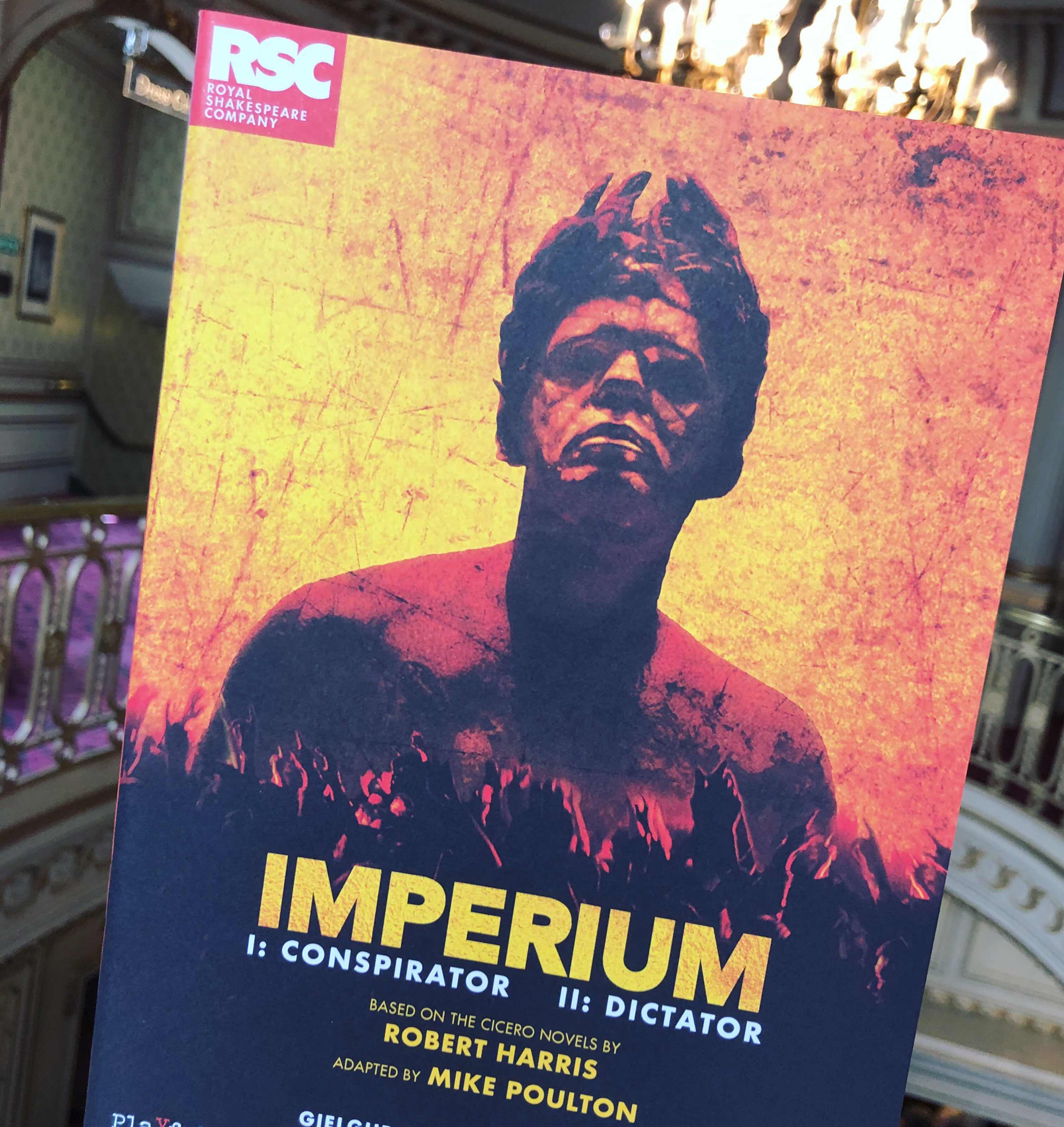
Theatre Review: Imperium

I’ve learned quite a lot about Ancient Rome this year. Most importantly, there are a lot more goats on the Via Appia than BBC history documentaries would have you believe. But also Roman politics makes for some fucking great, and depressingly relevant, theatre.


After the stonking success of Nicholas Hytner’s superlative defying Julius Ceasar at The Bridge at the top of the year (still the best theatre of 2018 for my money) comes the RSC’s Imperium two parter: Conspirator and Dictator (I’m going to refer to them as one play throughout, because laziness). Adapted by Mike Poulton from Robert Harris’ trilogy of books, which have just rocketed up my To Read List, Imperium tells the story of Cicero - Rome’s greatest orator - as he lives through the rise and fall of the Roman Empire and the slide into dictatorship. As such all of the events of Julius Caesar are retold here, covered in Dictator, but they’re not the sole focus of the play. Crucially, Imperium tells the Caesar story from the point of view of someone who was allied with neither Caesar nor any of the conspirators. In other words, it takes a story we all know, sets it in considerable political and historical context, explaining where Caesar came from and what happened after the Ides of March, and tells it in a completely different way.

And I loved the completely different way Poulton’s chosen to tell it. Structurally, first of all, it’s super clever - helpful given the total run time of the play is just shy of six hours. First of all, we’re given a narrator to help us navigate the epic sweep of the play in the form of Tiro, Cicero’s slave/biographer. In a play of this length and of this level of complexity (and with so many characters with very similar names) this really helps. It helps doubly that Tiro is also a character in the action. He’s not a Chorus in the Greek tradition, which are inevitably quite tedious, he gets stuck in too. A lovely, fun upshot of this is that his narration regularly gets interrupted by Cicero critiquing him - an early ‘this is a getting a bit expositionary, Tiro’ put me in mind of the great Basil Exposition running joke in Austin Powers and so made me giggle like an idiot. It helps the play flow that Tiro can switch seamlessly between reminding us who the character who’s just walked on is and responding to them. The second great structural idea is the fact that each play is explicitly broken into three hour long episodes, named in the programme based on who the main antagonist is. This is unashamed box set theatre and it totally works, both in making it manageable (and comfortable) for the audience but also in making sure that the action never slows. 

Poulton’s script is also great: quick, funny and rich. Another result, I think, of the box set structure is that it gives him more scope to make the script quite demanding for an audience to follow: he can pack in loads because we all know we’re getting a break to process it soon. As the man behind the RSC’s mighty Wolf Hall and Bring Up The Bodies adaptations, I already considered Poulton the King of Literary and this very much comets him there. His/Robert Harris’ characterisation is fantastic too. Everyone is vividly drawn and distinct and credible. The main characters, Cicero in particular, are joyfully rich. And I just adored seeing a new spin on the famous Julius Caesar cast which fully backs up my theory that Brutus is a fucking idiot and Cassius deserved better. It also makes Caesar a seriously nasty character in a way that he never gets to be in Shakespeare’s telling and brings some women into the narrative (hurrah!) It is, in short, a great piece of writing. That there is six hours of it is a gift. 

Directed by the RSC’s Artistic Director, Gregory Doran, this is also a great production. His direction is blistering, with a constantly shifting yet clear eyed focus delivered with a conspiratorial wink. The use of significant direct address to the audience - forming the additional character of ‘the rest of the Roman Senate’ - is really well done (even if it rather pales in comparison with the equivalent in The Bridge’s promenade Caesar, a comparison I’m trying hard not to make but in this aspect it’s almost impossible not to). Though it definitely overplays its hand in terms of contemporary relevance, I could 100% have done without a character in a Donald Trump wig, Doran is crystal clear about what this production wants to say. Anthony Ward’s design is, with one notable exception which I’ll come to, so atmospheric and so effective. Mark Henderson’s lighting is superb, and knocking on for a week later I’m still thinking of the final image of Conspirator where a bright white square of light picks out youthful antagonist Clodius - it’s so joyfully playful! Paul Englishby’s regal music and Anna Morrissey’s sprightly choreography keep this huge production on its toes. Everything feels as epic as the play is long. My one criticism is of the globe which hangs over the stage the whole time. I’m not sure what it’s supposed to do but what it actually does is restrict the view of the top of the stepped stage for quite a lot of the auditorium. It’s an irritant and adds nothing. It doesn’t actually look that nice either. Sight lines are also a slight issue when characters walk right to the front of the stage, which is also stepped down into the auditorium, and though I understand the purpose of this bit I’m not sure the same effect isn’t achieved when characters just stand on the actual stage where everyone can see them.

An epic production of an epic play requires an epic, and massive, cast, many of whom do double duty with a different character in each play. Richard McCabe has surely the best gig in the West End at the moment as Cicero. It’s a huge part and he is superb in it. Cicero is not always a likeable character, but in McCabe’s hands he is always sympathetic, credible and enormous fun. There’s such energy in his work and such detail too. The way he ages himself (makeup etc aside) is barely perceptible until it resolutely isn’t and you’re left wondering when it happened. Top, top stuff. As our lovable guide Tiro, Joseph Kloska, has as much work to do and does it with the same amount of energy and fun. There is a risk, I think, that Tiro could become purely a plot device who occasionally tells a joke in the wrong hands but there’s no risk of that with Kloska. Our erstwhile heroes are ranged against some cracking antagonists: Joe Dixon’s Catiline and Mark Antony are tremendous fun and dripping with malice, Peter de Jersey’s Caesar is a properly dangerous end of level baddie, Nicholas Armfield’s Clodius and Oliver Johnstone’s Octavian add some youthful opposition, villainy and hijinx to Conspirator and Dictator respectively. Nicholas Boulton’s Celer/Cassius also deserves a mention, especially his powerful Cassius who is exactly as exasperated with Brutus as I always am.  

Minor sight line quibbles aside, I thoroughly enjoyed Imperium. Great writing, clever production, brilliantly acted. Overall, a great day out in Ancient Rome. 

Imperium is at the Gielgud until September 8th.

I sat in E11 in the Grand Circle and paid £29.50 per show. 

Oh, and in case you were wondering about the goats...


Wednesday, 15 August 2018

Theatre Review: Pressure

As topics for plays go, the ins and outs of weather forecasting is not one that, on paper, sounds particularly thrilling. Even for a nation as obsessed with the weather as Britain is, it seems a bit much.

But, to borrow a phrase from the footsport, plays aren’t staged on paper and sometimes the most unlikely sounding ideas turn out to be some of the best. 

Pressure, the new play by actor David Haig with his playwright hat on, is a case in point. It tells the story of the rival British and American weather forecasting teams employed by the Allied forces in the run up to D Day. Their different interpretations of the various, technical signs (including, of course, air pressure) in the days preceding the initial favoured date for the major assault on the French beaches leads them to entirely opposite conclusions about whether it should go ahead or not. History ensues, so to speak.


The ultimate triumph of Pressure is this: it takes a show about the jargon heavy technicalities of weather forecasting and a historical event that everyone knows the outcome of and somehow makes a funny, engaging and unexpectedly tense play. It’s small scale wizardry on Haig’s part I think. The fact he chooses to focus not on the war itself but on the personal and unknown story of the British lead forecaster, James Stagg, and his relationship with Commander of the Allied Forces, Ike Eisenhower, is exactly the right one to achieve it. It allows him to bring in some personal subplots relating to the two men too, which are lightly and touchingly handled (I particularly enjoyed the thread about Stagg’s pregnant wife’s high blood pressure - the reference to another type of pressure is clever and not at all overdone).  

His characters are really vivid, well drawn and complex. Stagg softens from initial rude academic to genuine, touching human. Eisenhower is not only the upright historical figure (his relationship with his female secretary, Kay Summersby, is really well written). Summersby herself is strong but nuanced, a refreshingly complex portrayal of a military woman in this period. The dialogue is quick and witty but also contains some much heavier passages when the war itself does encroach on the action - a section about Eisenhower’s personal grief at the death of his child contrasting with his ability to send tens of thousands of men into combat at huge and obvious risk to their lives is beautiful. Tension builds through short and snappy scenes, often with little dialogue beyond contrasting strings of numbers being barked into various phones (which works much better than it sounds). If I were to pick at it, I think a few judicious cuts could be made here and there to bring the length of the first act in particular down by ten minutes or so, but really this is enormously accomplished and enjoyable stuff. 

It looks cool too. Colin Richmond’s design, with huge weather charts dominating the otherwise pretty sparse set, is evocative and effective. The way the charts are changed on the fly so quickly is also super impressive! It’s beautifully lit by Tim Mitchell and the use of his lighting and Andrzej Goulding’s video design to show the change in weather (and the action of the war) in the just barely visible but somehow dominant window of the set is great. Otherwise, it’s pretty much a straight down the line production, with nothing fantastically innovative going on, but it is none the worse for that. Everything that is going on is absolutely rock solid.

For many people, self included, the major draw of this production is neither writing nor production but cast and, specifically, David Haig himself who pops his actor hat back on to play James Stagg. And he is, as ever, fantastic. His Stagg is awkward and quiet but tenacious and principled. He’s a fish out of water (‘not a military man’, as every other character observes) with hidden depth that unveils itself gradually and unexpectedly as the play progresses. There’s a subtle physicality about his performance too - a slight stoop, a nervous tilt of the head - which I absolutely loved. It’s his face on the poster for a reason, y’know. However, his light is almost stolen by Malcolm Sinclair’s Eisenhower who is not only supremely charismatic and likeable but surprisingly deep and sympathetic too. His performance really captures the complexities and contradictions of the position of the head of any army. Adding some much needed feminist sass, and in some ways dominating both Stagg and Eisenhower, is Laura Rogers’ Summersby who also brings a good deal of heart to the play. She plays both the archetype strong WW2 woman and the, like, actual real woman aspects of her part equally well and certainly makes an impact beyond her stage time.

However implausible its set up may be, I really enjoyed Pressure. It’s so much more engaging and fun and gripping than it has any right to be and is a case study in just really superb acting. Regardless of how interesting you think it sounds, the joy of watching David Haig and Malcolm Sinclair slug it out is 100% worth the price of a ticket.

Pressure is at the Ambassadors Theatre until 1st September.

I sat in R4 in the stalls for this one - slightly obstructed due to the overhang of the circle but otherwise perfectly fine - and paid a princely £15 for the privilege. Highly worth it.