Monday, 17 November 2014

Theatre review: Behind the Beautiful Forevers

Are you bored of my blog posts extolling the virtues of every play the National Theatre ever stage? Then move along, there’s nothing for you here.


This weekend I headed to my beloved concrete block with stages in it to check out one of their new season plays, Behind the Beautiful Forevers. The play is based on the award winning non-fiction book of the same name by journalist Katherine Boo. It’s not an obvious choice to be adapted for the stage - an intimate account of the lives of the families living in Mumbai slum Annawadi, built on land owned by and in the shadow of Mumbai’s multi-million pound international airport, where Boo lived for three years to gather the material for her book. The implications on this for the play are clear: the characters it portrays are real, ordinary people, the events really happened and all of this only a few years old (Boo lived in Annawadi between 2007 and 2011). As I say, not an obvious choice and one that needed great sensitivity and skill to stage effectively.


The play (and book) follow the trials and tribulations of the Hussain family, kingpins of the local rubbish sorting business who are keen to get on, improve their home and eventually move to a new one where people won’t regard them as “shitty Muslims”. Matriarch Zehrunisa (Meera Syal) and eldest son Abdul (Shane Zaza) are the driving heart of the family; Zehrunisa for her take-no-prisoners business dealings and Abdul as the most skilled rubbish sorter in the district. Their lives are affected by their interactions with two other families in Annawadi. Jealous neighbour Fatima (Thusitha Jayasundera), AKA One Leg (for obvious reasons), renowned as the village whore, hates Zehrunisa and is determined to bring down her and her family. And ambitious local fixer Asha (Stephanie Street) is using every tool at her disposal to become a “first class person”, regardless of what corruption that might entail. The three families’ worlds collide dramatically when Fatima’s jealousy of the Hussains adding a shelf to their kitchen leads her to set herself on fire and blame it on the family. Abdul and two other members of his family are arrested for inciting her suicide and Zehrunisa refuses Asha’s offer to fix the situation before it becomes, well, a situation - for a fee, of course. The resulting court case threatens (and nearly succeeds) to ruin the Hussains and lays bare the hypocrisy, corruption and paradoxes of modern Mumbai.


As a story, it feels huge, epic. And the fact that it’s a true story just gives it more power. I really loved this play for a whole host of reasons, but the dramatic sweep of its truelife narrative is definitely one of the biggest. It’s a great, tragic, thought provoking story and the stakes are so much higher because it’s all true.


Unusually for me, another huge reason why I loved this play is the production, in particular the sound and lighting effects. Directed with verve and pace by Rufus Norris (incoming Director of the National of course, so no pressure) this is a loud play, both in its incidental music and soundtrack - banging bhangra - and its effects. It looks loud too. The Mumbai bit of the set occupies the back of the stage and intrudes into Annawadi (the front of the stage) via a huge, ever present neon billboard, looming luxury tower blocks and the imposing fence that separates the slum from the airport beyond. Annawadi itself is stark and simple, strewn with plastic bottles and the occasional muted burst of colour (which sets off the beautiful jewel coloured costumes perfectly).


Now, if you’re planning on seeing the play yourself please do not read the next paragraph. It contains spoilers for a couple of serious production pieces that will lose their impact for you if you're expecting them. Ok? See you at the paragraph after next.


The fact that the play is set next to an airport is something that the designers really have fun with. They create a lighting/sound/video effect that has a jumbo jet coming into land across the ceiling of the theatre. It is visually stunning, so loud it made my seat shake and, frankly, terrifying when you’re not ready for it. This happens twice - I was glad, as the second time I definitely appreciate the artistry more - and the first time is made all the more spectacular and disorientating by the fact that as soon as the plane has ‘landed’ hundreds of plastic bottles are dropped onto the stage from the ceiling above. It’s noisy and chaotic and perfectly creates a sense of what life in Annawadi must be like. The final scenes of the play see half of the revolve retracted leaving a gaping hole in the middle of the stage into which one key character jumps in search of his next big rubbish picking opportunity. Epic staging for an epic story.


Hi people who are going to see the play - welcome back!


There are two other reasons to love this play, and ones that put me back on more comfortable territory. David Hare’s writing is, in short, excellent. The play is structured as a series of monologues (which I guess are verbatim passages from the book, or at least very closely adapted) joined up by punchy, fast paced, sweary dialogue. The use of the monologues to make and emphasise major points and themes could feel clunky or preachy in a lesser writer’s hands but here they seem natural, give a rhythm to the play and allow insight into the huge cast of characters that we otherwise just wouldn’t get.


Moreover the acting, from the National’s first ever all Asian company, is pretty much faultless. For obvious reasons, Meera Syal is being billed as the star of the show and she is fantastic; her monologues in particular are incredibly strong. For me though the real stars of the show performance-wise are Shane Zaza as Abdul and Anjana Vasan as Manju (Asha’s daughter, on course to be Annawadi’s first college graduate and passionate about the right of everyone, girls in particular, to an education). Both deliver fantastically nuanced performances, pitched and paced exactly right, with real emotional strength (translation: they both made me cry). It is a universally strong cast though, there isn’t a weak link beyond the occasional dropped accent.


Behind the Beautiful Forevers is a play that I think will stay with me for some time (and if its quality is indicative of what Rufus Norris’ tenure as the NT’s Director will be like then bring him on). It’s themes of what does it take to get on in life, what happens when everyone is trying to get on in life in the same finite space and how you be a good person in terrible circumstances all invite one question: if it were you, what would you do? We might not approve of Asha’s corruption or Abdul’s decision to stop handling stolen material even though it generates a lot of his family's income, but in the same situation why would we act any differently? Why would our way be better? And there’s no easy answer to that.


Behind the Beautiful Forevers opens at the National on 18th November and runs all the way through to April. No excuse, then, for you to not go and see it.  


Wednesday, 29 October 2014

Review: The James Plays

I spent eleven hours in the theatre on Saturday.

Eleven.

It was bliss.

But why, I hear you ask? Surely you have better things to do with you life! Well a) no, I really don't and b) it's not every day you get to see three sequential history plays in order on the same day, especially when those plays are the critically lauded James Plays at my beloved National Theatre.

The James Plays, the first ever collaboration between the National Theatre of Scotland and the National Theatre (of everywhere else), premièred to rave reviews at the Edinburgh Festival. They tell the story of the first three Stewart Kings of Scotland and, more fundamentally, of the formation of Scotland as the country we recognise today.

The NT is showing the plays individually in rep and also held a limited number of trilogy days, the last one of which is where I found myself on Saturday. As an aside, I loved the experience of seeing al three plays on the same day (as I did seeing Wolf Hall and Bring Up The Bodies on the same day a few months ago) and highly recommend this sort of thing if you ever get to do it. But I digress. Here's some brief (as I could make them) thoughts on all three plays.

(Spoiler: I loved them.)

James I: The Key Will Keep the Lock
Poor old James I had a bit of a rough start in life. Specifically, he was captured by those pesky English at age 13 and held prisoner for 18 years, including a long spell as prisoner of Henry V (whose brief cameos in this play are significantly less flattering than other accounts of his life). James is restored to his throne by Henry as a ploy to stop the wayward Scots from fighting with the French against Henry's army and tasked with repaying Henry's 'kindness' with a hefty ransom to be paid in Scottish gold. He's also married to an English bride, Henry's cousin Joan Beaufort, to further secure his loyalty. Mistrusted by Scottish nobles who don't know or especially care who their young King is, James makes it his mission to deliver peace to Scotland and enforce the law of the land, even against the noble families who have seen their power grow exponentially in his absence. Suffice to say said nobles are not universally behind his plans...

It's a cracking, busy story which I found the most compelling of the three, narratively speaking. It's also unexpectedly funny, almost a comedy of manners, as James struggles to fit in with both his English Queen and his Scottish subjects. The scenes with Joan are some of the most enjoyable, especially their fantastically awkward marriage scene which contains some of the most delicious extended silences I've seen on the London stage. The production beautifully evokes a Scottish medievalness (clearly not a word) too, all wild Celts, chanting, booze and complaints about the weather. It's certainly the play of the three that felt the most Scottish to this outsider.

Performance-wise, it's top notch. James McArdle is hard not to warm to as a strong, stoic and principled King James. His performance does take some adjusting to - his stumbling over words and taking long pauses mid-sentence initially came across to me as someone struggling to remember their lines - but ultimately he gives James a nervousness and a sense of outsiderness which makes him a more believable character. He is also phenomenally good looking. Shallow, but true.

The strongest acting of the trilogy comes from Blythe Duff and Gordon Kennedy. They play several parts each across the three plays but are introduced in James I as Isabella and Murdac Stewart, the chief rivals to James' throne. Kennedy's Murdac is an unsentimental pragmatist whilst Duff's Isabella is a dangerous she-wolf. They're a fantastic couple and their performances provide much of the comedy and much of the sense of danger throughout the play. Credit also to Peter Forbes' Balvenie, a nervous minor noble in this play who is loyal to James as long as he can help elevate his status, intelligently played in James I as a real, desperate nonentity.

It's a great start to the trilogy and sets the ground nicely for...

James II: Day of the Innocents
We next pick up the story after James I has been assassinated, with his son and heir James II suffering terrible nightmares about his childhood. Abandoned by Queen Joan as a boy, he is 'cared for' by the warring whims of noble families desperately vying to control him and his throne. Amidst this chaos and danger he makes one friend, William Douglas (Balvenie's son and heir), and the two dream of the day they can rule Scotland together. As they grow up, this picture becomes more complicated and James and his demons must fight to hold on to his crown.

This play is an entirely different kettle of fish. It's use of nightmare sequences, puppetry and, for want of a better word, spooky lighting gives an altogether more otherworldly atmosphere. It's notably more serious and with a much smaller plot. It feels less Scottish somehow and much darker, which I suppose is appropriate for a play which deals extensively with ideas of madness and what affect it can have. And, contrary to the generally accepted critical view that it's the weakest of the three, it was actually my favourite part of the trilogy, if I was forced to choose.

The acting is universally great again, as you'd expect given it's the same cast. Blythe Duff and Peter Forbes both return in the same roles they had in James I, although both characters are so changed that you could argue it's only the name that's the same. Duff's Isabella now has much more of a supernatural role, almost like one of the witches in Macbeth, telling the young King how evil his family is and how awful he's destined to be. Forbes' Balvenie is transformed into the great noble he wanted to be and, as a result, is a bit of a shit; violent to his son and awful to basically everyone else. (I kind of loved him.) Gordon Kennedy returns too, this tine as scheming chief noble Livingston whose control and manipulation of the child King ultimately quickens his downfall. Murdac is a more sympathetic character, but Kennedy is excellent again and does snakelike very well.

Andrew Rothney is a really sympathetic James II. Given the amount of this part that is spent in nightmare sequences and flashbacks, it would be easy for him to become a completely unbelievable character but Rothney manages to avoid this. I found the nightmare scenes amongst the most effective in the whole trilogy and this is in large part due to his utterly believable sense of terror. The final nightmare where - spoiler alert - he brutally murders longtime friend William Douglas is genuinely quite scary, but also very touching. Mark Rowley is an excellent Douglas too; by degrees sweet and caring, funny and swaggering, arrogant and dangerous and carrying all off with a lightness of touch which makes his development and ultimate downfall thrilling to watch.

Ok, keeping up? Good. Onwards...

James III: The True Mirror
Generally agreed by critics to be the highlight of the trilogy, James III is actually more concerned with the women of the Stewart court. It follows our third James - a camp, charismatic, cultured non-conformist intent on spending money that his nation can ill afford and shagging anything with a pulse - and his intelligent, politic and loyal Queen, Margaret of Denmark, as she attempts to hold his country together.

As my flippancy there may suggest, I don't agree with the critics that this is the best of the trilogy. In fact I found it the most tedious. This is not to say it's a bad play in any way, shape or form (it isn't) but it is the most overtly political and the one that seeks to tap into the pre-referendum introspection in Scotland the most. In a post-referendum world (remember those three weeks where we all cared about the referendum?) it's a less interesting, less insightful prospect and in places I found the lack of subtlety - 'hey, this could still apply today!!!!!' - irritating at times. This wasn't helped by the sudden and jarring leap to the cast being in modern dress after two plays in period costume.

I also found James III by some distance the least sympathetic James. He is essentially just unpleasant; a sort of Gilderoy-Lockhart-meets-Mercutio-in-Baz-Luhrman's-Romeo-and-Juliet preening peacock with very few redeeming features. It's not that the acting was bad, it really wasn't, but the character is just an arse. It was frankly a relief when - spoiler alert again - he was stabbed to death by his much maligned son James IV.

The person who's generated the most buzz and comment around this play is Sofie Grabol, of The Killing fame, who plays Margaret. And credit where credit's due she is magnificent, an instantly likeable and kick ass foil to her husband who gets most of the best written dialogue in the trilogy. She is an arch bitch - the way she destroys one of James' more inconvenient mistresses by simply pointing out that she's not as pretty as he says she is is just perfection - but also a fantastic, principled and funny leader. It's a great performance which really lifts the play. Blythe Duff and Gordon Kennedy return for a third run, as a funny and wise court aunt and an ambitious courtier/potential lover for Margaret respectively - and are excellent again, as are the rest of this ensemble cast who really must've earned their money on three show days!

Special mention also to the music used in this play. If you feel like a folksy version of Don't You Want Me Baby and/or Born This Way is something you'd enjoy - and it damn well should be - then go and check out James III and make sure you're in your seats in good time for both acts.

Overall, the James Plays are just brilliant. Any one of them taken on its own is a fantastic work of drama but taken together they're a thrilling, fascinating thing. There are just a couple of shows left now - and only of II and III - but if you can get your hands on a last minute ticket you definitely, definitely should.


Thursday, 23 October 2014

Book Review: Mary Boleyn - Alison Weir

If I say the name Mary Boleyn to you, what instantly comes to mind?

I'll give you a minute.

If anything, I'm guessing you got as far as Anne Boleyn's sister? Henry VIII's mistress? Francois I's mistress? Well done, because that's about as much as anyone knows about her.

She's also a really interesting and sympathetic character in Wolf Hall which is why I decided I wanted to devote my precious free time to reading a whole book about her. Plus I really enjoyed Alison Weir's Six Wives of Henry VIII (featuring, of course, a Mary Boleyn cameo). An Alison Weir biography of Mary Boleyn seemed right up my street.

And it was, to a very large extent. Weir's book - Mary Boleyn: 'the Great and Infamous Whore' - is extremely compelling and immaculately researched. The writing is, as Weir's books always seem to be, some of the best in popular history; accessible, intensely readable and assuming only the most basic prior knowledge. Drawing on contemporary sources, and often discrediting later ones, the book paints a much fuller picture of 'the other Boleyn girl' than you'll get from any fictional account. She's not just Anne's sister or Henry's mistress, she's an interesting character in her own right who Weir clearly feels affection for.

Perhaps the most enjoyable aspect of the book is its comprehensive debunking of many of the accepted facts about Mary and her life. Did Francois I ever called Mary 'the great and infamous whore'? Nope, there's no credible evidence for that. Think her son, Henry Carey, was Henry VIII's bastard? Sorry, wrong again. Despite a lot of academics, contemporary and modern, suggesting that he was there's no credible evidence for that either. (Interestingly, Weir builds a very credible case that Mary's daughter, Catherine, is a much more credible potential Royal bastard.)

How about Mary herself, was she stupid and unimpressive? Well, she clearly had some questionable taste in men in her early years but the idea that she was the slack jawed yokel of the Boleyn clan is a gross oversimplification. And she was the last of the Boleyn siblings to die, happily married and in obscurity, so she can't have been that stupid now, can she?

The examination of contemporary sources to provide the evidence for all of this debunking is incredibly impressive, almost forensic. It's difficult to argue with any of Weir's conclusions without doing some serious research yourself. Who has time for that, really?

I suppose the only thing that spoiled my enjoyment of this book is that the contemporary sources on Mary are so few and as a result there are so many things that we will just never know about her. I'm no historian - this much is probably apparent - and I like my pop-history books to be able to give me some definitive facts. There are just so few of these about Mary Boleyn. After a while, I found the constant uncertainty frustrating. This isn't Weir's fault, clearly, but I just found it annoying that there's no way to prove all of her excellently constructed arguments right or wrong. I dropped history at AS level for a reason, I suppose.

Weir has written extensively on the Tudor period and, since I'm still going through my Tudor phase (though how long that will last since I've just picked up Hilary Mantel's French revolution set A Place of Greater Safety remains to be seen), I intend to read more. I'd certainly highly recommend Mary Boleyn to anyone interested in learning more about its much maligned subject, the Boleyn family generally and Henry VIII's court.

Wednesday, 3 September 2014

10 Books that have stayed with me

Have you seen the '10 books that stayed with me' Facebook meme? You know, the one where - funnily enough - you name ten books that have stayed with you in some way and explain why. I mean, the clue's in the name really.

Anyway, I got tagged in it and as an avowed bookworm of 28 years standing I thought I'd give it a bash. I cannot abide long Facebook posts though - they make my page look messy and upset my OCD - so I've decided to do it as a blog post instead. I'm a rebel like that.

So here are my ten, in some kind of rough chronological order sort of:

1. The Very Hungry Caterpillar - Eric Carle
The first book I ever remember reading by myself. It's not big and it's not clever, but my god did I love it. If you're unaware of the highly complex plot, a caterpillar is born and proceeds to eat a lot until it turns into a butterfly. On the way, your author (aged approximately three at the time) learned numbers, days of the week and different fruit. The collage style illustrations are gorgeous too. Apparently this is also George W Bush's favourite book. Make of that what you will.

2. Sam's Sandwich - David Pelham
Another high brow option, Sam's Sandwich is about a boy making a sandwich for his sister and putting lots of bugs and gross stuff in it in the process. This one has stayed with me because I strongly remember my mum reading it to me and I know it's one of her favourite kids books that she's always used in her teaching career, which makes it doubly special because I know what an amazing teacher my mum is and how many other kids loved hearing her read my copy of this book as much as I did.

3. The Jolly Christmas Postman - Janet and Alan Ahlberg
I swear we get out of kids books in a while. Another one that I remember reading with my parents and I loved it because it was reading but it also had little surprises and games in it (I remember a jigsaw in particular) which I thought was basically magic at the time.

4. Charlie and the Chocolate Factory - Roald Dahl
I think this is the first 'grown up' book I read by myself. I read all of Roald Dahl's books when I was growing up - either for school or for pleasure - and it was hard to pick just one for this list. The Twits, Matilda and The BFG could easily be on here too. I went with Charlie and the Chocolate Factory in the end because it was the first one I read and I can still remember exactly what my copy looked like (hardback with a purple and orange striped spine if you were wondering). Plus it's just such a lovely story. I think it should be mandatory that everyone read it at least once before the age of 18.

5. Harry Potter and the Deathly Hallows - J K Rowling
My relationship with Harry Potter got off to a slow start. I didn't read any of the books and was initially fairly ambivalent to the films (apart from the second one, because Lockhart). Then when the final book was released my dad bought it for me for me basically as a joke (and because it was only £5 at Asda). I reluctantly sat down to have a read through...and from about page 7 was completely hooked. I've subsequently read all the books several times and become obsessed with the series and the world around it. Thanks dad (and Asda).

6. The Liar - Stephen Fry
I read this by the pool on holiday in Greece (Zante, because I am a deeply classy person) and loved it. Stephen Fry's novels are fantastic and this was my gateway into them. It's a fantastically written, fantastically weird story (no spoilers - you should read it yourself) with fantastically realised characters that I think I read in two days, if that. This one isn't included for any sentimental reason or anything, just because it's one of the books I've most enjoyed reading.

7. Beginning - Kenneth Branagh
I love autobiographies so there had to be a couple on this list. I've reviewed this on the blog recently and I just love it. I'm not much of a re-reader but this is one I've read all the way through a couple of times and dip into whenever I need a bit of a motivational shot in the arm. As I've said, it's such an inspirational book (KenBran is my hero on so many levels) and it also contains the following epic quote about being 28 that I just adore: "at twenty-eight, the chances of really knowing something are slim, and the possibility of losing what grasp you do have, great". Preach. 

8. Red Carpets and Other Banana Skins - Rupert Everett
Another autobiography, another book I've reread and another I'm including just because it's so enjoyable. I dip into this one whenever I need a pick me up or am in the mood for some grade A bitchiness. The follow up, The Vanished Years, is also utterly fabulous.

9. Bread - Paul Hollywood
Do cookbooks count? I'm going to say that they do. I mean, it's a book right? Arguably, this book is the one on the list that's had the most impact on me as a person. See, I had a long period of unemployment in 2012/3 and I did not care for it. Which is to say I utterly, utterly hated it and spent a huge amount of tine feeling completely miserable and useless. One of the things that really helped me get through was learning to make my own bread and this was the book that inspired - and taught - me to do that. I've made loads of the recipes from this book and they're all super easy to follow and basically idiot proof. And much cheaper than therapy.

10. Wolf Hall - Hilary Mantel
The best book I've ever read, full stop. Pretty easy really.

Now I know I have some bookworms amongst my readers, so step up people. You know who you are...

Wednesday, 27 August 2014

Emmys Best Dressed

I miss awards season.

There's just not enough pretty in the world without it, y'know? People need more excuses to wear ridiculously expensive OTT gowns and for that to be ok. We've had nothing like that since Cannes. Sigh.

Luckily, for reasons best known to someone else, the Emmys (and the MTV VMAs but OMG did you see the car crash that was that red carpet?!) have their ceremony outside of awards season providing a little glamour fix to keep me going. It's not high high fashion - no Dior, no Chanel, no Gucci Premiere, only one Armani Prive - but it's something.

Here's my pick...

January Jones in Prabal Gurung

Image source
My favourite of the 8 million red dresses on the very red Emmys carpet. I love the detail of the fabric, I love the high-low hem and I love the overall impact that this gown has. It's definitely the biggest 'fashion moment' of the lot.


Jessica Pare in Lanvin

Image source
Opting not to wear a gown, this classic Lanvin LBD is gorgeous. No fuss, no messing around, just understated elegance. There wasn't much black on the carpet this time so nice to see it being used to effectively here.


Heidi Klum in Zac Posen

Image source
Heidi so often looks like mutton dressed as lamb so it's nice to see her in something much simpler. This dress is all about the fit - which is perfect - and finding the right shade of red to match her skin tone. I'm also a tiny bit obsessed with the cape detail. Good to see something less structured from Zac Posen getting a red carpet outing too.


Amy Poehler in Theia

Image source
We don't often see Amy P in all out glitz but man does this look work for me. I love the delicate beading, minimal styling and the silver against her skin tone is beautiful.


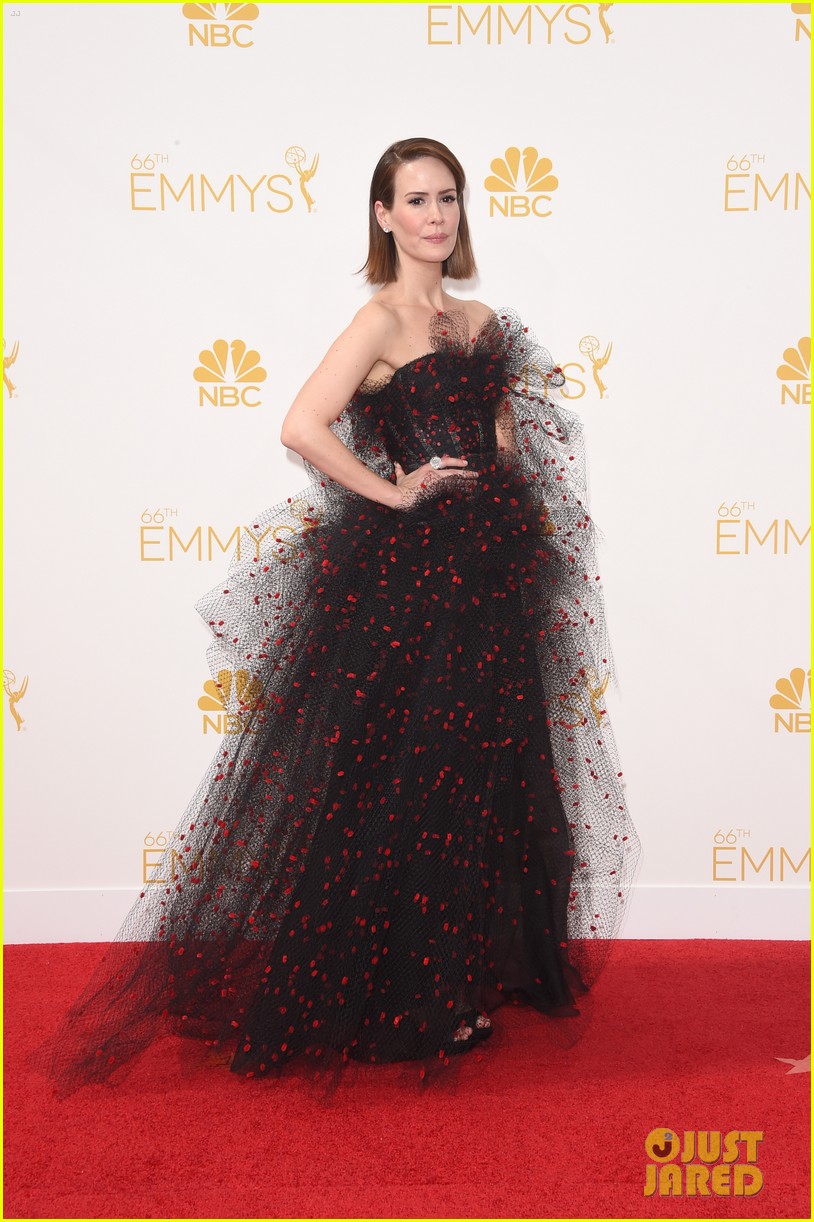
Sarah Paulson in Armani Prive

Image source
One of the few people to wear a traditional fashion big gun, I love this intricately detailed gown. Red and black is a fantastic combination and this is such an effective way of using it. The Gothic net overlay is to die for.

Friday, 15 August 2014

Review: Wolf Hall and Bring Up The Bodies

As I imagine I've mentioned many times before on this blog, Hilary Mantel is my favorite author and Wolf Hall and Bring Up The Bodies are my favourite books. Ever. (Sorry, A Song of Ice and Fire.)

Apparently I’m not the only one who feels that way. Both books have legions of fans and have won the Booker prize. And now both have been adapted for stage by the Royal Shakespeare Company (and screen too - the BBC’s take is currently in production).

The phrase ‘adapted for’ is often enough to strike fear into the heart of book lovers, particularly when the book or series in question is one you really love, but when it’s done well it’s exhilarating to see the characters you love so much brought to life. It’s a risky business though, especially with books as popular and critically acclaimed as Mantel’s. I doubt I’d have been the only one who would've been devastated if these plays hadn't done justice to the books.

Thankfully, this isn't a concern: the plays are utterly, utterly fantastic.

Unusually for me, the first thing I want to rave about is the direction. The source books are long, there’s no getting away from this fact. There’s easily five or six hours of material in each and I was concerned about how this would be condensed into watchable plays. Obviously there are some cuts - mainly to secondary characters and their scenes - but the action is so swiftly paced that these are kept to a minimum. But the action doesn't feel at all rushed though, it just feels urgent. This sense of momentum is helped along by clever stage direction in which characters who are in successive scenes rarely actually leave the stage. They walked to the edge of it, turn round and come back, which sounds daft but actually really works in keeping the play pushing forward. The completely bare ‘concrete’ set helps here too - as there are no changes in scenery, and only the occasional prop, the idea of the characters entering and leaving different rooms or buildings is visually less important. Who cares if they go off stage or not?

With source material as good as these plays have, it would be deeply depressing if they weren't well written. And thankfully they are. Mantel writes excellent, punchy dialogue and much of this is incorporated wholesale into the script, which is uniformly brilliant. The thing that really struck me about the writing though was the difference in tone between Wolf Hall and Bring Up The Bodies. This is evident to an extent in the books but was really emphasised in the plays, with Wolf Hall being almost a knockabout comedy while Bring Up The Bodies something much darker. That’s an oversimplification of course, most of my blogs are, but there was a marked difference and it was worked very effectively, really adding depth to the characters’ development and story.

Excellent writing deserves excellent acting and these plays have the latter in spades. I said in a post earlier this week that My Night With Reg must have one of the best ensemble casts in London and surely Wolf Hall and Bring Up The Bodies, who share one cast, have the other. There’s not a single weak link amongst them, even though most also have the challenge of playing multiple roles (often multiple important roles too: the actor who plays Cardinal Wolsey in both plays also has Archbishop Warham in the first and Sir John Seymour and the jailer at the Tower of London in the second for example!) It feels rude to single any one person out from such an outstanding ensemble, but Nathaniel Parker and Lydia Leonard are a perfect Henry VIII and Anne Boleyn capturing with fantastic effect the arc of their relationship. Parker’s Henry was particularly good, I felt, in Bring Up The Bodies where he’s allowed to show a bigger range of emotion - from besotted to angry via afraid and injured (physically and emotionally).

The one person who it would be rude not to single out, though, is Ben Miles. His Thomas Cromwell is spectacular. It’s a huge part in terms of sheer amount of lines, he’s rarely off stage in the entirety of the almost six hours combined running time, but it’s even huger in terms of the range and depth of character. He plays Cromwell as an East End wide boy type - in no way how I imagined him but, if you think about it, exactly what he was - all quick wit and cunning. In Bring Up The Bodies the character effortlessly develops into something darker and more ruthless. Nothing about his performance feels forced or obvious, it feels natural and completely believable. It’s genuinely scintillating stuff to watch and a performance that demands attention (and surely some awards). I could rave about him for days but I imagine you’d all get bored and wander off. Suffice to say I was impressed, almost Branagh-levels of impressed.

Wolf Hall and Bring Up The Bodies, taken as one piece of work as they should be, is by some distance the most enjoyable, exciting and technically accomplished theatre I've seen in London this year. I would also recommend seeing the two plays in one day as I did because I can only imagine how awful the anticipation of seeing the second one is if you have to wait. I mean I only just lasted the three hours between matinee and evening. It’s really, genuinely great stuff that everyone - familiar with the book or otherwise - should definitely see. 

Wednesday, 13 August 2014

Review: My Night With Reg

First things first, this post is about a play. Not anything else you might have been thinking of. Just to clear that up. 

Moving on...

My Night With Reg is an early 90s play by British playwright Kevin Elyot. It follows a sextet (great word) of gay men over four years of their collective life and individual lives. Over the course of the play (a short course it should be said, the play is only about 110 minutes long and runs sans interval) it is revealed that all but one of the group - uptight, chaste, sweet Guy - have slept with the titular but absent Reg. There’s flamboyant David, who is Reg’s long term partner; rich kid John, the object of Guy’s unrequited love, who is having a 6 month affair with Reg; odd couple Benny (an alpha male bus driver) and Bernie (“he redefines dull”) who’ve both had one night stands with him; and naive new kid in town Eric who also has a one stand stand with Reg but doesn’t even get to know his name. In the second scene of the play it is revealed that Reg has died of Aids.

This isn’t an ‘Aids play’ in the same way that, say, Angels in America or The Normal Heart is though. It’s not angry and it’s not political. Aids is never directly mentioned once, the power and weight that the word undoubtedly carries is implied through the excellent writing and acting instead. It is a tragic play, certainly, but it’s also a very funny comedy of manners. A tragicomedy that actually works, that rare thing.

This is a phenomenally well crafted play with beautiful dialogue, both funny and tragic. It plays on its themes of love, loss and betrayal subtly but fully. The scenes between Guy and John in particular are fantastic, Guy’s all consuming love for John being both the source of much of the humour and even more of the tragedy of the play. Trying very hard to avoid the dreaded spoilers, there are two deaths in this play and the contrasting ways that John reacts to them is heartbreaking. Although the play is set in the 1980s, the way it deals with its themes so sensitively allows it to still be 100% relevant today - despite it’s love of The Police.

It helps that the cast must surely be one of the finest ensembles on the London stage right now. They are all excellent, but special mention must go to Jonathan Broadbent’s adorable, neurotic Guy and Julian Ovenden’s complicated John. The former in particular could easily become an unbelievable stereotype in less skilled hands, something that would be a disaster for the heart of the play and that Broadbent deftly avoids. Ovenden’s John almost crumples before your eyes over the course of the play, starting off as the cocky, unreliable cad about town but ending as a heartbroken, scared shell with every single one of his insecurities, fears and losses written on his face. He also looks pretty damn good naked, just FYI (if you’re not ok with some fairly prolonged male nudity then this is not the play for you).

If I had to criticise, then the play’s third scene (which I’m trying very hard not to spoil) is fairly predictable once you realise what situation is being played out. That doesn’t diminish its emotional impact for one instant, though. And I did have some issues with the character of Bernie, who is so boring and socially unaware that he does at times feel a bit like a caricature. That said, his moment of real emotion (again, avoiding spoilers) is beautifully written and acted. Minor quibbles aside, this is a really excellent evening of theatre.

I’d urge you to go and see My Night With Reg, but as it’s playing at the tiny Donmar Warehouse the whole run is already inevitably sold out. The Donmar does do seated and standing day tickets though if you have the patience for such things. It’s certainly worth it.